It’s Friday y’all! Let’s fire up our core on #FireUpYourCoreFriday and slide into the weekend feeling good! Oh and it’s Fruity Friday too! What other F words can we come up with (positive ones of course LOL) that will get us motivated to eat well and focus on firing up our core?
Day 17 Plan:
Food Challenge: Fruity Friday! Try to have a serving of fruit with every meal!
All the evidence, both anecdotal and research-based, suggests runners who avoid strength training are making a mistake. Our tissues have the “capacity” to handle a certain level of work before fatigue. “Load” is the amount of stress you put on your body through training, balanced out by recovery through rest and nutrition. Combined, capacity and load limits determine how resilient a runner’s tissues are. When those limits are low, the odds for injury go up and performance can go down. This is where strength training comes in!
Running coach and elite runner, Jason Fitzgerald, is a big fan of pumping some iron, and learned about strength training the hard way. “My decision to roughly triple the amount of strength training in my own program came as a result of figuring out the causes of injuries and speaking with a lot of physical therapists,” he says. “Even though I was ‘strong’ in that I could run 90 miles per week, run a sub-five-minute mile, or qualify for Boston with a big cushion, I was weak in terms of muscular strength.”
Fitzgerald weaknesses fell in areas that typically plague runners, his hip and glute muscles. He knew he had to change his mindset around strength work. “Just as importantly as needing to get stronger, I needed to realize that strength training is not cross-training for runners. It’s just part of the normal training workload for runners who are interested in chasing their potential.”
Fitzgerald recommends strength training to all of his clients. “Ideally, every run is followed by 10 to 20 minutes of runner-specific strength or core work.”
It’s interesting that Fitzgerald qualifies strength training as part of a runners normal training and NOT as cross training. This is because when we do strength exercises that are specific to a runners needs, we add to our running prowess. Cross training, cycling or swimming, while a great addition to our activity routine, is not running specific so while it will help us build strength and endurance, it does not benefit us directly as runners. In fact, Fitzgerald urges runners to do less cross training and more strength work specific to runners. He goes as far to tell his runners to skip any high impact classes like body pump and kick boxing as these activities require us to move outside the “running plane” and can cause injuries.
I’m not saying you should go out and cancel your other classes or stop cross training. Just be aware of the types of movements you are doing and be careful with exercises that require high impact movements that are not specific to meeting your running goals.
When Fitzgerald first began his strength training regimen, he wanted to dial in to a runner’s needs. After only a few weeks he said, “I started with body weight exercises and progressed from there. All of my pain went away after adding in the strength work.”
If you suffer from niggles here and there and aren’t being consistent about your strength training, you’re neglecting part of your training. Strength work is not cross training…it’s an important part of a runner’s normal routine!
Day 13 Plan:
Food Challenge – Meatless Mondays
Quick Core Workout (Morning preferably)
Coffee Break Workout (Short breaks throughout the day)
Day 13 Exercises
Bonus Option #1 – Clam Video Workout (only 2.5 minutes per leg!)
Bonus Option #2 – Nike Runner’s World Dumbbell Routine (see steps and video below)
Food Challenge: Meatless Mondays – No meat today! How can you be creative with your meals to avoid eating meat on meatless Mondays?
Quick Core Workout: Would love to see this getting done first thing in the morning to wake us up and get our body moving!
Coffee Break Workout: Great for a midday stretch out, especially if you do a lot of sitting for work!
Quick Core Workout
Coffee Break Workout
Day 13 Exercises: 3 sets of 10 (“how to” videos below)
Hip Extension with Stability Ball
Birg Dog
Kickback with Resistance Band
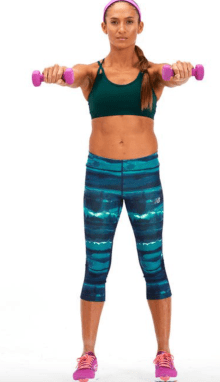
Dumbbell Clocker Shoulder Raise
Forearm Planks – 3 x :45 (1 each round)
Bonus Option #1 – Clam Video Workout: This routine is runner specific because it targets our hips and glutes with exercises recommended by physical therapists for weak hips and glutes!
Bonus Option #2 – Nike Runner’s World Dumbbell Routine for Runners: We don’t have any days dedicated to arm strength this month but it is still important for our running and our overall health to work on strength in our arms and back. The Nike Runners’ World arm routine takes about 3 minutes and all you need is a small pair of dumbbells OR your running shoes. The steps are listed below but you can also watch the video here. The arm portion is the 2nd half of this workout so you will need to skip through the first portion. You may remember this from doing it a few months ago but if not, please check out the video above and follow along. Super quick yet super effective burn and all we need to build runner specific arm strength!
Side Arm Raise – 5x each – Palms facing front, palms facing in towards body, palms facing back
V-Raise – 5x each – Palms facing front, palms facing in, palms facing back
Front Raise (arms parallel) – 5x each – Palms front, palms in, palms back
Around the World – 5x each – Palms facing in, pinkies touching, thumbs touching
Overhead Press – 5x each – Thumbs facing in, palms facing in, pinkies facing in
Scarecrows – 5x each – Palms facing towards front of body, palms facing body, palms facing out to the side
Standing Dumbbell Flys – 5x each – Palms out, Palms down, palms facing up
Small Circles – 5x each – Palms facing down, palms facing out, palms facing back
Day 13 “how to” videos:
Hip Extension with Stability Ball – Lye on your back (supine) with your heels on a stability ball hands flat on the floor at your sides. Digging your heels into the ball lift your hips off the ground until they are in line with your torso and legs. Hold for a count and return to the starting position.
Bird Dog – You can do this exercises by just holding the position and coming back to the start or touching your elbow to your knee as you see in the video.
Kickback with Resistance Band – Think of a standing donkey kick just with a resistance band to make it a little more challenging.
Dumbbell Clocker: Hold light dumbbells. Imagining that you’re at the center of a clock facing 12, raise your arms until they’re parallel to the ground at clock position 12, then lower. Repeat at 1 and 11, 2 and 10, and 3 and 9. Perform this sequence 4 more times.
Forearm Planks – Keep working with the basic plank from your knees until you are strong enough to come up onto your feet then hold and repeat!
The weekends are our chance to stretch our legs and go long, but there’s more than just running involved if you want to stay healthy, injury free AND feeling good for the week to come. Read through the info below now and check out what’s in store for us over the next couple days!
In the long run…
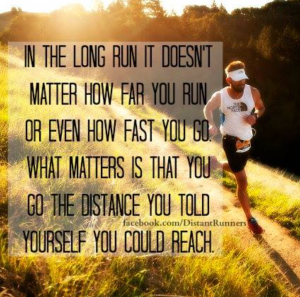
It doesn’t matter what “long run” means to you. It can mean 2-4 miles, 7 miles, 10 miles, 15 miles, 20 miles…it’s relative to where you are right now.
It doesn’t matter how fast you go. In fact, it’s more important to slow down and find a pace where you can talk easily and breathe without huffing and puffing. To go the distance, especially a “new to you” distance, the slower pace is imperative for building aerobic endurance and avoiding injuries.
In the end, the only thing that really matters is going the distance you told yourself you could reach.
So no matter what that distance is, get ready for it. Plan your route, your running posse, your nutrition and fuel, your hydration. Plan ahead so you make it happen. Plan ahead so you can go the distance!
Day 11 Exercises: Scroll down for descriptions and instructions on warm up drills and legs up the wall
Day 12 Exercises: Active Recovery / Yoga for Runners
Active Recovery – An active recovery day is like a short cat nap that allows you to feel good for the rest of the day. The day after your long run, you are including activity at an easy intensity to get blood flowing to your muscles to help them recover quicker. You can do a SHORT & SLOW run (20-30 min at an easy pace) or low impact activities like cycling, swimming, or yoga to complement the demands of your high-impact running workouts.
Leg Swings: “Leg Swings” are one of the moves featured in the Active Warmup circuit from Runner’s World, a workout designed to get your body loose and ready to run!
Hip Hurdles: This dynamic warm up exercise opens up our hips and gets us ready for our long runs. I do this before EVERY run…not just long runs! Watch the video below, then remember that you DO NOT need a hurdle. Hold onto your car, a wall, a bench…whatever is close by and pretend you have a hurdle to get your legs over. Go forward and backward 5-10 times per leg. This is not time consuming but can make a difference with how you feel during and after your run.
Legs Up the Wall: The best thing about this recovery move is its ease. All you have to do is find a wall, lie perpendicular with your butt up against that wall, extend your legs up, open your arms out to the side, and relax. No fancy equipment necessary. You don’t even have to do it for long, 5 – 15 minutes at most.
The pose helps reverse the typical actions that happen in our lower bodies as we sit and stand all day, and it’s especially useful right after a workout. It’s best to do this move as soon as you can after a workout (within 30 minutes) because having your legs warmed up and your veins dilated will make circulation to the rest of your body easier. In essence, this inverted pose aids your overall recovery by draining fluids that are pooling in your legs, while also stretching your hamstrings and relieving a worn out lower body.
Throwing your legs up a wall creates a positive circular flow to your core. Circulation matters when it comes to recovery because lactic acid and waste don’t leave your body very quickly and being in an inverted position helps it to drain faster.
Here’s how to do it: Lie down on your back and try to get your butt as close to the wall as possible, extending your legs up, perpendicular to the floor. Open your arms to the sides, palms up. Flex your feet for an added hamstring stretch. If that’s too uncomfortable, you can scoot away a bit so your legs are at an easier angle.
You’ll reap the benefits holding this position anywhere from 5 to 15 minutes. Start out small with 5-8 minutes and work your way to holding it for longer. The hardest part about this move is making the time and letting your mind relax when you have lots of other things to get to. And let’s face it, you just spent lots of time running and we all have other things to do.
You should notice less soreness and tightness after your harder runs and workouts and discovering a way to have a less creaky neck and better posture are also a nice added benefits.
Yes fellas, this move is for you too. We will all benefit from adding this to our routine regularly. Give it a try!
7 Key Stretches for Runners: Last but certainly not least…time for good old stretching. Again, it’s best to do these stretches while you are still warmed up from exercising and your muscles are supple and pliable. But if you can’t get to it right away, make time later in the day or before you go to bed and work out that stiffness that creeps in after pounding the pavement!
That’s all for now Crew. It’s a lot of info and a lot of things to fit into our weekend. Remember that planning ahead and making time for yourself is key to getting it all done AND to feeling strong and ready for the week ahead! 🙂
As we get farther into the month, it’s easy to fall off track and let the days slip by without getting our workout in. And as the days slip by, it’s gets easier and easier to just let them go. And once a few days go by, it’s so much harder to get started again.
The secret to avoiding that “restart” is to KEEP GOING! It’s easier to stick with our routine then it is to start again. Even if it’s just a quick workout, even if you only run a mile, even if all you can fit in is your strength, or just a plank and wall sit…KEEP GOING!
If you’ve already fallen behind, DON’T try to make up days. Trying to make up days will wear you out, make you tired and overwhelmed…make you miss MORE days.
Instead forget about what is in the past and jump back in TODAY with Day 9. Legs and Core…it’s a great workout all on it’s own!
The Secret…
Day 9 Plan:(“how to” videos below)
Food Challenge – Thirsty Thursday: Drink 8+ glasses of water. Start hydrating for weekend long runs!
Quick Core Workout
Day 9 exercises – 3 sets of 10 (Planks are :45 starting today!)
Bonus – Coffee Break Workout
Quick Core Workout (#QCW) and Coffee Break Workout
Quick Core Workout
Coffee Break Workout
Day 9 exercises: 3 Sets of 10 (“how to” videos below)
Straight Leg Kicks
Metabolic Up and Down
Standing Rainbow
Crunch or Reverse Crunch on Stability Ball – Try the Reverse Crunch first. It’s tough but it’s a great core strengthening exercise!
Plank 3 x :45 (one :45 plank each round) – If you are new to planks please watch the “how to” video below!
Day 9 “how to” videos:
Standing Straight Leg Kick
Metabolic Up and Downs (with or without weights)
Standing Rainbow
Reverse Crunch
Plank
You’re tired, you’re sore, you just want to skip a day…or two…or just be lazy till Monday.
Wouldn’t it be great if we were able to strengthen our “prime movers” to keep us healthy and strong BEFORE we got injured?
“Prehab before Rehab” What does this statement mean to you?
Prehab means taking care of the areas important for our quality of movement, longevity of our limbs, and the highest level of performance possible BEFORE we get injured. If we take the time to work on some key areas (in this instance our prime movers) before we get injured then our risk of injury goes WAY down and we can avoid needing rehab!
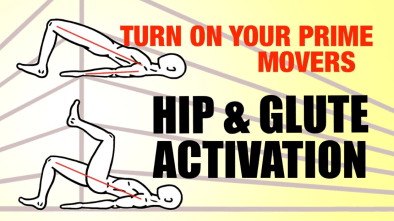
Our hips are the ‘prime movers’ in any traveling movement. This includes changing levels or heights such as in a squat, jump, or lunge, walking or running, cycling or even dancing! The hips are the body’s center of gravity and the foundation for the spine and upper body.
Where the hips go…the rest of the body will follow.
All too often, our modern lifestyle leads to dysfunctions in movement. The simple act of ‘sitting’ leads our body to develop many different compensation strategies as the musculature of the hips learns to ‘turn off’ over time and will not just ‘turn back on’ when needed to walk, jump or run.
The longer we sit, the more that our hip muscles will not be ready and able to work when we need them. The neuromuscular connection to these muscles become inhibited or turned off. These inhibited neuromuscular connections make it harder for our hips muscles, including the glutes, to be active and maintain their strength and endurance. The end result is that they begin to alter our biomechanics and our body creates different strategies of compensation in movement patterns.
Activation Exercises are designed to strengthen the neuromuscular connections to these specific muscle groups in order to restore our normal biomechanics and optimize our movement. When our body is able to use proper biomechanics, it will move more efficiently and we will be able to maximize use of these important muscles with the least amount of effort. This provides us, as athletes, more opportunities for success.
There are lots of great hip and glute activation exercises we can use and today we are focusing on a few of these key moves that will help us get stronger and “maximize our output”. But these exercises require workout out. While they are important, there is something we can do during simple everyday activities that will also help us activate theses areas…
Practice Standing!
Practice standing?? Yes! We can activate our hips and glutes when we are standing, walking, even running! We can strengthen these areas WHILE we are doing what we love to do!
Once we have developed a sense of what it feels like to activate the muscles of our hips during exercises that target these areas, we want to keep the glutes turned on as much as possible, even when we’re just standing! How? When you are standing, walking or running, engage your hips and glutes. It’s simple. Just SQUEEZE!
The more that we practice using this neuromuscular connection, the stronger and more stable it will become. Stronger and more stable hips and glutes will activate when we need them because they will be ready to move! Basically, the more that we practice squeezing, or engaging, our glutes, the easier it is to recruit them (without thinking about it) when we’re ready to walk, run, stand up or just move!
Practice standing and turning on the Glute Complex and Hips as much as possible today. Try it in your normal everyday situations. When you stand you squeeze, when you walk you squeeze, when you run…you squeeze!
Day 7 Plan:
Food Challenge – Tiny Tuesday! Every Tuesday this month is Tiny Tuesday! This just means we want to eat small portions. We should do this everyday but especially on Tuesdays in August!
Quick Core Workout & Coffee Break Workout (see below)
Day 7 exercises (see below for list and “how to” videos)
Bonus – Practice your squeeze! During normal activities like standing, walking and running
Day 7 exercises: 3 sets of 20! (“how to” videos below)
Low Squats – How low can you go? Yes this means going beyond 90 degrees with your legs! See video below for the proper way to do it and stay safe!
Donkey Kick + Fire Hydrant – Technically this is 2 moves but we like to roll them into one and get more out of each exercise.
Clams – A basic but important hip/glute activation exercise
Single Leg Bridge – single leg exercises are key to running strong!
Wall Sit (3 x :30 – don’t forget to squeeze!)
Day 7 “how to” videos:
Low Squat (AKA Goblet Squat or “butt to the ground”)
Donkey Kick + Fire Hydrant – We’ve done both of these moves many times…now we’re just putting them together to make it one killer move!
Clams – You know this exercise…keep your feet and toes together and if you want a little additional challenge lift your feet off the floor just like in the Clam Video Workout we all love.
Single Leg Bridge – Great exercise for our Core, Back, Glutes, Hips and Legs!
Wall Sit – Three separate times at least :30 each with tight squeeze at the end!
Speed Work: This week’s speed work is meant to challenge you. Once a week, we want to push ourselves and this is that day! But pushing ourselves doesn’t always mean running an all out pace. For this workout, you want to go the distance so think around your half marathon pace. If you’ve never ran a half marathon, use your most recent 5K time then add about 60-75 seconds per mile.
The Workout:
If you are training for a 5K to 10K
1 mile warm up
Mile repeats (2-3 miles with a .25 mile walk or jog in between each mile)
1 mile cool down
Total of 4 – 5.5 miles
If you are training for a 15K to a Marathon
1-2 mile warm up
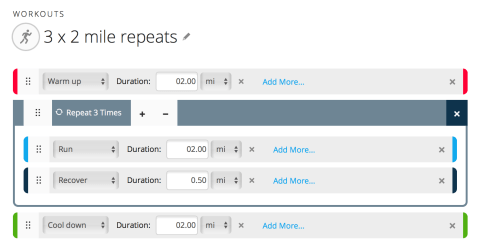
2 x 2 OR 3 x 2 mile repeats with half mile (.5 mile) in between each set of 2 miles)
1-2 mile cool down
Total of 6-8 miles (for 2 x 2) or 8-10 miles (for 3 x 2)
This workout will help us hold that “faster than our easy pace” for longer. It will increase our VO2 Max while also teaching our legs to turn over faster. The key here is to stick to Half Marathon pace. You DO NOT need to run faster. You want to hold that pace for the full 2 miles for each set then take the .25 or .5 mile walk/jog then start your next 2 mile repeat. Tough…yes! But so is that goal race you have coming up!
Questions? Please ask! This is the first time we are working on longer repeats so please reach out to me with any questions. If you want to set this up in your Garmin and do the workout on the road (as opposed to the track which I would prefer since this would be a lot of circles) please see the screen shot below.
This is the workout I will be doing on Wednesday. You can adjust the mileage and recovery period to your needs. Let me know if you have questions about how to set it up!
Time to turn on those PRIME MOVERS and get our hips and glutes moving! Remember, where the hips go….the rest of our body follows!
Mondays in August are for full body strength and today each and every one of you you will be a…
Today’s exercises will test all of our strength. Shoulders, arms, core, glutes, legs…it’s all there. It won’t take long but it will make you stronger!
It’s Monday Crew…let’s do this!
Day 6 Plan:
Food Challenge – Meatless Mondays
Quick Core Workout & Coffee Break Workout
Day 6 exercises
Bonus Workout
Food Challenge: Meatless Mondays – No meat today. Can you go all day without eating any meat? Check your labels!
Quick Core Workout: Would love to see this getting done first thing in the morning to wake us up and get our body moving!
Coffee Break Workout: Great for a midday stretch out, especially if you do a lot of sitting for work!
Quick Core Workout
Coffee Break Workout
Day 6 exercises: 3 sets of 10 (“how to” videos below)
Hip Extension with Stability Ball
Birg Dog
Kickback with Resistance Band
Dumbbell Clocker Shoulder Raise
Forearm Planks – 3 x :45 (1 each round)
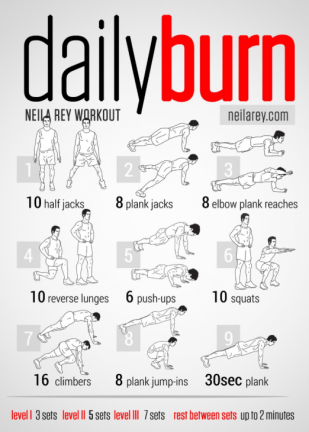
Bonus workout: Quick extra burn on a Monday. Have a few rounds in you?
Hope to see LOTS and LOTS of GRILS GONE STRONG today! A couple strong men too…can’t forget about Martin and Ray! 🙂 Let’s do this!
Day 6 “how to” videos:
Hip Extension with Stability Ball – Lye on your back (supine) with your heels on a stability ball hands flat on the floor at your sides. Digging your heels into the ball lift your hips off the ground until they are in line with your torso and legs. Hold for a count and return to the starting position.
Bird Dog – You can do this exercises by just holding the position and coming back to the start or touching your elbow to your knee as you see in the video.
Kickback with Resistance Band – Think of a standing donkey kick just with a resistance band to make it a little more challenging.
Dumbbell Clocker Shoulder Raise (Around the World)
Forearm Planks – Keep working with the basic plank from your knees until you are strong enough to come up onto your feet then hold and repeat!
Think of your core muscles as the sturdy central link in a chain connecting your upper and lower body. Whether you’re hitting a tennis ball, mopping the floor, or running on a trail, the necessary motions either originate in your core, or move through it.
No matter where motion starts, it ripples upward and downward to adjoining links of the chain. Thus, weak or inflexible core muscles can impair how well your arms and legs function. And that saps power from many of the moves you make. Properly building up your core cranks up the power. A strong core also enhances balance and stability. Thus, it can help prevent falls and injuries during sports or other activities. In fact, a strong, flexible core underpins almost everything you do:
Everyday acts. Bending to put on shoes or scoop up a package, turning to look behind you, sitting in a chair, or simply standing still — these are just a few of the many mundane actions that rely on our core and that we might not notice until they become difficult or painful.
On-the-job tasks. Jobs that involve lifting, twisting, and standing all rely on core muscles. But less obvious tasks, like sitting at your desk for hours, engage our core as well. Phone calls, typing, computer use, and similar work can make back muscles surprisingly stiff and sore, particularly if you’re not strong enough to practice good posture and aren’t taking sufficient breaks.
A healthy back. Low back pain, a debilitating, sometimes excruciating problem affecting four out of five Americans at some point in their lives, may be prevented by exercises that promote well-balanced, resilient core muscles.
Sports and other pleasurable activities. Golfing, tennis or other racquet sports, biking, RUNNING, swimming, baseball, volleyball, kayaking, rowing and many other athletic activities are powered by a strong core. Less often mentioned are sexual activities, which call for core power and flexibility, too.
Balance and stability. Our core stabilizes our body, allowing us to move in any direction, even on the bumpiest terrain, or stand in one spot without losing our balance. Core exercises can lessen your risk of falling.
Housework, fix-it work, and gardening. Bending, lifting, twisting, carrying, hammering, reaching overhead — even vacuuming, mopping, and dusting are acts that spring from, or pass through, the core.
Good posture. Weak core muscles contribute to slouching. Good posture trims your silhouette and projects confidence. More importantly, it lessens wear and tear on the spine and allows you to breathe deeply. Good posture helps you gain full benefits from the effort you put into exercising, too.
Weak, tight, or unbalanced core muscles can undermine us in any of these realms. While it’s important to build a strong core, it’s unnecessary to aim all our efforts at developing rippling abs. Overtraining abdominal muscles while snubbing muscles of the back and hip can set you up for injuries and hold us back from achieving our fitness goals. If washboard abs are your holy grail, it’s essential to trim body fat through diet and aerobic exercise and build strong abdominal muscles through frequent core exercise sessions.
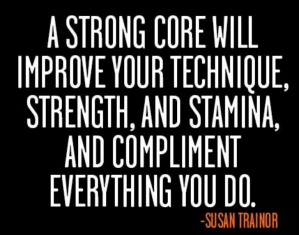
Good thing it’s CORE STRONG month in the #CoreCrew! Let’s build our core strength to that will compliment our technique, strength, and stamina…in addition to everything above that a strong core does for us.
It’s Friday Crew…let’s knock out this core work and get ready for a great weekend!
Day 3 Plan:
Food Challenge: Fruity Friday! Try to have a serving of fruit with every meal!
Quick Core Workout (#QCW) & Coffee Break Workout
Quick Core Workout
Coffee Break Workout
+ 3 Sets of 10 (“how to” videos below)
Figure 8 with Twist
Sumo Squat with Side Bend
High Side Leg Raise
Standing Dirty Dog
Wall Sit & Plank (3 x :30)
Day 3 “how to” videos:
Figure 8 with Twist – Can also be done with a single dumbbell just hold one end in each hand
Sumo Squat with Side Bend – Love the addition of the small weights here
High Side Leg Raise
Standing Dirty Dog – similar to a fire hydrant but standing!
Our Moms on the Run Wednesday evening class got rained out. The rain by itself wouldn’t have stopped us…but the lightening flashing down way too close was a deal breaker. A few of us were already at the park so we decided to go for margaritas! 🙂
At dinner we were chatting…about running of course! Somehow we got around to taking about running on different surfaces and I mentioned how much I hate running on sidewalks. This is no secret for anyone who runs with me as I am very verbal about it. Concrete is the worst surface to run on. It’s dangerous because of sidewalk cracks and holes and breaks in the surface which we can get our feet caught on, trip and fall, break stuff, scrape stuff…it’s just downright dangerous.
But there’s another reason I don’t like running on sidewalks. Side walks are made of concrete which is the hardest surface we can run on. According to a RunAddicts.com article,
Physicians at the Women’s Sports Medicine Center in New York City recommend avoiding concrete completely. If runners choose to jog on concrete, they should have shoes with the maximum level of cushioning and support in order to avoid landing with too much force. Sport medicine doctors warn that forceful landings on concrete can be strong enough to shatter blood cells and reduce the amount of oxygen that the blood can carry to organs. Furthermore, the hardness of the surface can make runners vulnerable to shin splints.
The Runner’s World article “The Hard Road: Racing on Concrete” claims that concrete is 10 times harder than asphalt! They also say that while asphalt is not as risky as concrete, it too can cause stress fractures and runners should make sure they have good running shoes with a decent amount of cushioning to ensure they don’t get injured.
So what surfaces are best for running? Grass and dirt trails get the highest endorsements from experts as long as runners choose areas without a lot of scattered rocks, debris and disruptive tree roots.
Bottom line…
While many doctors advocate running on natural surfaces, others disagree. The irregular surface of dirt and other soft surfaces are hazardous and runners often fare better on smooth and hard surfaces.
Since most runners get bored sticking to one surface, there is no harm in varying surface as long as concrete is used rarely and running shoes are in good shape. Switching surfaces teaches the body to adapt and avoid injuries due to repetition. Various running surfaces can stress the body and feet in different ways, working different muscles or joints, requiring different positions and postures so changing it up is definitely a good idea.
For me, running on concrete is my last choice. I will switch to asphalt whenever possible. If I run more than a mile or so on concrete, I can feel my shins getting mad. If you suffer from shin splits or are susceptible to stress fractures…please avoid concrete sidewalks if possible. If you choose to run on the road, run opposite of traffic and keep an eye on everything coming your way. Be safe!
What is your favorite surface to run on? Do you find that you feel differently when you change it up? Are there certain areas you avoid because of the terrain? Share with us in your daily post and let’s see what the #CoreCrew family trends for surface running are. 🙂
On to our Thursday workout! Core and Legs…let’s go!
Day 2 exercises: (“how to” videos below)
Quick Core Workout – 1 round minimum
+ 3 Sets of 10:
Straight Leg Kicks
Metabolic Up and Down
Standing Rainbow
Crunch or Reverse Crunch on Stability Ball (Try the Reverse Crunch first then if that is too difficult do regular crunches on the SB to build core strength)
Plank 3 x :30 (one :30 plank each round) – If you are new to planks please watch the “how to” video below!
Bonus:
Coffee Break Workout
Food Challenge – Thursday: Thirsty Thursday! Drink 8+ glasses of water today! Great way to get hydrated for long runs coming up this weekend!
Quick Core Workout (#QCW) and Coffee Break Workout
We all know the importance of strong hips and glutes….if you’re new or have been ignoring these areas and wondering why your hips or knees ache, then it’s time to join the glute camp and build strength in these areas!
Hip and glute specific exercises are great and will help us avoid injuries and run stronger, but did you know that hill workouts are also a great way to build strength in these areas while we do what we love most…run!
Running hills is the perfect compliment to our strength routines, but please don’t think that if you do hill workouts you can skip your exercises. Yes, we still need to do both, that’s why hill running is complimentary not in replace of… moving on! 🙂
As promised, since Monday’s workout was longer, our Tuesday workout is shorter this week at only 10 minutes. But if you have a few extra minutes, the bonus is awesome and one I have been doing everyday! Don’t forget your wall sit and plank and you’re done!
Day 17 exercises:
Fitness Blender Glute and Thigh Routine – 10 min
Wall Sit – :60
Plank – :60
Bonus – Clam Video Workout – 2.5 min per leg
Fitness Blender Glute and Thigh Routine:
Bonus – Clam Video Workout: I am loving this short routine and I hope you will try it. Save it and throw it in whenever you have a few extra minutes or you’re just laying around watching TV. I’ve been loving this after a tough workout too because I feel like it gives me a good stretch and loosens me up too.
Speed Work or Strength?
Y’all know I’ve been listening to the Strength Runner podcast with Jason Fitzgerald and he has a short episode that I listened to recently that cover the importance of hill workouts, when these workouts should be done and who should run these types of workouts.
Spoiler alter — the “who” is EVERYONE! Every runner stands to benefit from the power, speed, and strength gained from structured hill workouts. (That means me too so I need to find hills more often or bite the bullet and get on my treadmill!)
“Hill workouts are the unsung hero of speed work. Any runner can do them – and every runner will benefit.” – Jason Fitzgerald
Hill workouts are hard and unpleasant. They challenge your endurance, speed, and strength. There’s no other workout like running hills and that’s just why they’re so valuable.
Running uphill (against gravity) stresses your body in a unique way that you can’t mimic on flat land. That stress results in some fantastic adaptations and benefits:
There’s less impact running uphill so it’s easier on your joints and connective tissues
Hills “force” you to run with better form, reinforcing a more efficient stride
Running up steep grades builds power more safely than running fast on flat terrain
Hills provide the most specific strength work runners could ask for
Hill workouts build strength, speed, endurance, VO2 Max, and every other metric runners care about!
Speed Work Options: This week we have some options. I live in flat Florida so the only way to get in hill work is to run bridges or get on the treadmill. If your situation is similar and you can’t get to a hill to get in this wokrout, then do the same tempo workout we did last week and plan ahead to try one of these hill workouts next week. I plan on doing the long rep hill workout on Tuesday and the 25 minute tempo workout on Wednesday. You can do both of these workouts close together since the long hill workout is not at top speed but instead just helping you build an aerobic base. Just make sure you roll and stretch in between these workouts and that you feel good going into the next day before you attempt the tempo again.
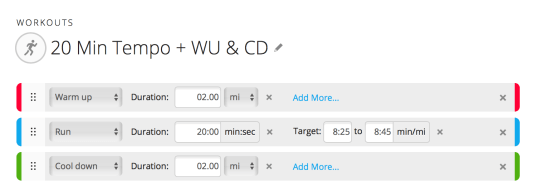
If you nailed the tempo workout last week and you feel good about it, stretch out the middle tempo portion and make it a 25 minute tempo instead of a 20 minute tempo. See the 20 minute workout laid out in my Garmin screen shot below.
Option #2: If you have a good hill to run close by or a treadmill you can use then try one of the hill workouts below. Decide which workout to do based on where you are in your training cycle. If you are working towards a fall race, you are in the beginning of your training cycle and you should do the Long Hill workout (workout #2). This workout is good for building your endurance base and increasing strength.
If you have a race coming up and you want to build some power and speed that will translate into better performance sooner, then do the Short Reps workout (workout #1).
Hill Workout #1: Short Reps
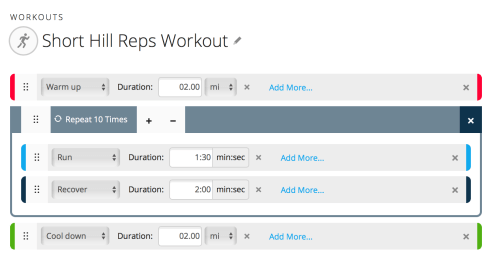
Short hill repetitions are the traditional workout that most of us think of when we envision a hill workout. They’re usually 60-90 seconds in length with a jog down recovery (you turn around at the end of the rep and run easy down to the bottom before turning around to start again) done at about 3k-10k pace on a 4-7% grade hill. In other words, they’re short and fast!
These are classic VO2 Max workouts which help the body increase its ability to deliver and process oxygen to hard-working muscles. There’s also a significant strength aspect, making this a great workout for those who struggle with injuries.
Here are a couple examples of short rep hill workouts:
10 x 90sec hills at 5k Pace
8 x 60sec hills at 3k Pace
An example of how to set up this workout on your Garmin
Hill Workout #2: Long Reps
These types of hill workouts can be used for a variety of reasons:
Early strength-building during the base phase of training
A type of tempo workout (if the pace is kept under control)
A replacement for shorter hill reps if an easier day is needed
Since a slower, but longer hill workout like this is more aerobic, it’s best used in the earlier phases of training. An example of this workout is running:
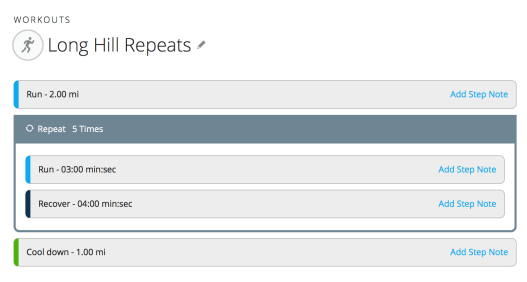
5 x 3 min hills @ half marathon pace with a jog down recovery. It will be tempting to run down hill to fast especially after a minute or so of cooling down but keep it super easy. If you’re speeding back up slow to a walk so you bring your heart rate down before you turn around and go back up!
An example of how to set up this workout on your Garmin
As you can see, the long hill workout is at an easier pace, while the short rep workout is half the time but at a much harder effort. “How” you do these workouts and “when” you do these workouts is key to seeing the results you want on race day so read through the options again and think about which one is best for you depending on where you are in your training. Don’t have a race your working towards? Do the long hill workout and focus on improving your base endurance.
If you don’t have a Garmin or maybe just aren’t into tracking everything, you can do these workouts without the data or alerts, just do a 1-2 mile warm up then set up a run/walk interval timer for each segment. Remember to keep your recovery walk or jog nice and easy to bring your heart rate back down and be ready to go back up again!
Tuesday “to do” list:
Fitness Blender Glute and Hips Workout
:60 Plank
:60 Wall Sit
Bonus – Clam Video Workout
Plan your speed work – when will you do it and which workout will you do. Plan to have enough time to get through the workout while taking the appropriate rest intervals If you are short on time, rushing and do not take the enough rest you are not getting the same benefits from these workouts.
Plank a hill workout for later in the week or next week if you’re not able to get it in this week
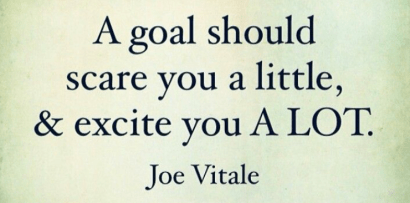
We’ve all got goals. They might be running goals or more general fitness goals. No matter what our goals are, it’s little thing we do that get us closer to reaching them. Those little extra strength exercises. throwing in a tough hill or speed work out, planning ahead to ensure you have enough sleep, are well hydrated and have the proper nutrition, all these little things help us get closer. Scary to go after something you want when it isn’t the easy road…scary but exciting! Let’s go out and crush some goals Crew!









 Strong to the Core