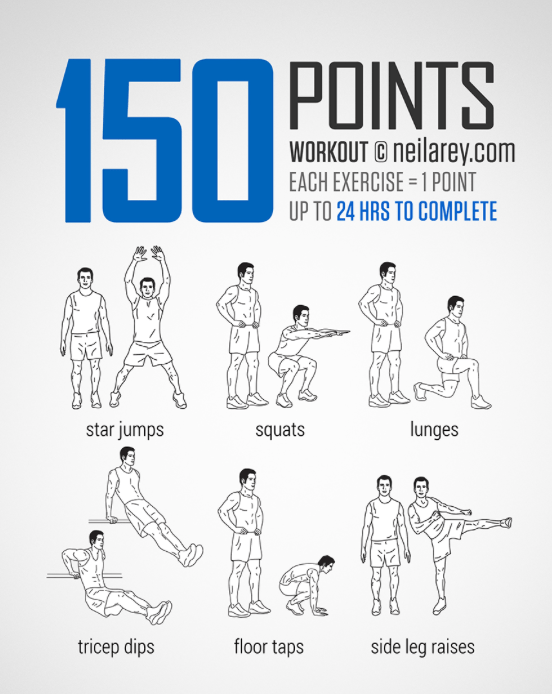
Super simple today Crew. Pick some exercises…do 150 reps. You can spread these out throughout the day, or knock them out all at once. Your workout. Your choice. These are ALL great exercises for runners.
Need to work on some additional arm strength? Do more tricep dips. (Our triceps are THE most important when it comes to arm strength for runners.)
Have weak quads or sore hamstrings….more squats!
Want some more core, hip and outer leg strength? Side Leg lifts!
Floor taps anyone? I’ve never seen them before…they look interesting. I’m excited to try them and see what happens. 🙂
Cardio? Star jumps!
Whatever it is you choose. Do it strong. Want a well balanced workout? 25 reps of each exercise. Need more help in certain areas than others, pick your poison and rock it!
Choose 150 reps and knock it out! Don’t forget your push ups! Add 3 sets of 10 and you are done!
Quick workout today Crew. 15-20 minutes tops and you are done….but it won’t be easy! This is a tough workout but follow along, take a quick break when you need to, then get right back to it.
This is one of our favorites…cause it hurts so good!
Fire up those glutes and let’s build a solid base we can run strong and long on!
Day 9 exercises:
Wall Sit – :60
Push Ups – 3 x 10
Donkey Kick Workout
Wall Sit – :60
Donkey Kick Workout:
Speed Work: Tempo Run – Many people are a little confused about what a tempo run really is. A tempo run is a faster-paced workout also known as a lactate-threshold, LT, or threshold run. Tempo pace is often described as “comfortably hard.” Tempo running improves a crucial physiological variable for running success: our metabolic fitness.
“Most runners have trained their cardiovascular system to deliver oxygen to the muscles,” says exercise scientist Bill Pierce, chair of the health and exercise science department at Furman University in South Carolina, “but they haven’t trained their bodies to use that oxygen once it arrives. Tempo runs do just that by teaching the body to use oxygen for metabolism more efficiently.”
Tempo run work because they increase your lactate threshold (LT), or the point at which the body fatigues at a certain pace. During tempo runs, lactate and hydrogen ions–by-products of metabolism–are released into the muscles. The ions make the muscles acidic, eventually leading to fatigue. The better trained you become, the higher you push your “threshold,” meaning your muscles become better at using these byproducts. The result is less-acidic muscles (that is, muscles that haven’t reached their new “threshold”), so they keep on contracting, letting you run farther and faster.
To get gains from this workout, you’ve got to put in enough time at the right intensity. For most runners, tempo runs are too short and too slow. “You need to get the hydrogen ions in the muscles for a sufficient length of time for the muscles to become adept at using them,” says Sharp. Typically, 20 minutes is sufficient, or two to three miles if your goal is general fitness or a 5-K. Runners tackling longer distances should do longer tempo runs during their peak training weeks. Below is a breakdown of what your tempo run should look like. This is does not include warm up and cool down which should be an additional 15 minutes on both sides. These are just your “comfortably hard” miles. Add 30 minutes to this workout with your warm up and cool down. Yes, this is time consuming. Plan ahead to make sure you have time to get it done…otherwise you ARE NOT benefiting from this workout!
Tempo Distance: Remember to add a 15 minute warm up and 15 minute cool down. This is just the “workout” portion.
5K: 2-3 miles
10K: 4-6 miles
Half Marathon: 6-8 miles
Marathon: 8-10 miles
If you are looking at this workout shaking your head and saying “no way” then here’s is a way to ease into this workout. Anyone can do this workout…YES EVEN YOU! 🙂
Beginner Tempo Workout: 5 x 3 minutes at tempo pace, 60-second easy jog in between each one (if you have to walk during the recovery, you’re going too hard). If you need to walk for :10-:15 at the beginning of your “rest period” that is ok but don’t walk the whole :60. Catch your breath then go into a nice super easy jog before you go back into your tempo pace.
Finding Your Tempo Pace: To ensure you’re doing tempo workouts at the right pace, use one of these four methods to gauge your intensity.
Recent Race: Add 30 to 40 seconds to your current 5K pace or 15 to 20 seconds to your 10K pace.
Heart Rate: 85 to 90 percent of your maximum heart rate.
Perceived Exertion: An 8 on a 1-to-10 scale (a comfortable effort would be a 5; racing would be close to a 10).
Talk Test: A question like “Pace okay?” should be possible, but conversation won’t be.
The easiest methods to gage your “perfect tempo pace” are 1 & 4. Number 1 will be the most specific but I like #4 also because if you can talk comfortably…you are going to slow. If you can’t eeek out 2 words…you’re going too fast!
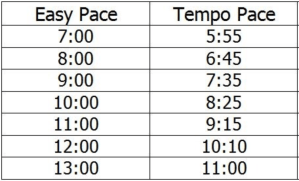
Here is a good chart with tempo paces. Don’t take these as “concrete times” this use it as a guideline keeping the “rules” above in mind. If you can’t get out the “pace okay?” sentence…you’re going too fast. If you can chat away…speed up!
Although they don’t need to be, tempo runs can be confusing. This is one of the most misunderstood workouts we run into. Pun intended. 🙂 If you have questions, reach out to me. I am here to help!
Plan Ahead Crew! If you just wing it with this workout it will not go well. Give yourself plenty of time, have water handy or close by, get in a good long warm up (take more than 15 minutes if needed), then GO FOR IT!
End with a chuckle: Cute little video with a few reasons why you shouldn’t run today. I laughed…but seriously, these are not great reasons. Except the one about being in pain. If you just painted your toenails…you better still be running! 😉
It’s important to get moving every day of the week because that’s what gets our juices flowing and helps us maintain a healthy lifestyle. Monday is the most important workout day of the week because today is the day we wash away the weekend and set the tone for the week!
We don’t get lazy and glutinous on the weekend so you’re probably sore and achy, but the best way to avoid further muscle soreness and strip away the achy muscles is to get MOVING! This is me this morning, but I am moving!
Today’s workout isn’t as tough as last week. 20 minutes and you’re done. Start out with some push ups, battle your way through our 15 minute Nike Strength Routine for Runners, a second set of 10 push ups, one wall sit, then a final set of 10 push ups and you are done!
Day 8 exercises:
10 Push ups
Nike’s Strength Workout for Runners
10 Push Ups
:60 Wall Sit
10 Push Ups
Nike’s Strength Routine for Runners: Build power, endurance and speed with this 15 minute strength routine from Nike and Runner’s World. All you need is a pair of shoes and a small set of weights if you want to add some resistance. No weights? No problem…you can do this without them!
There are 2 parts to this video. When the first part ends grab some water, take a break and wait for it to roll over to part two. The entire video only takes 15 minutes and most of us have done this several times now so you should be getting better at it!
Veterans…this is not new, in fact only a few months old…but it never hurts to hear it again, right?
Newbies…please read…this is good stuff and it will make a difference in our long runs!
Running involves sacrifices. We sacrifice time with our family and friends, sleep, fun nights out, and sometimes even a fun night in after a hard day at work…all because we need to get in our miles.
So when we step out the door to start our run, of course we just want to start running!
This rush to get it going can mean the difference between a great long run and a soul crushing, painful long run…and it could spell disaster in the form of an injury.
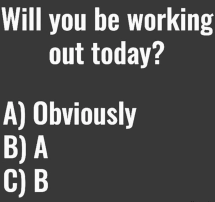
Most runners want to get faster and avoid injury. This is where we really have to weigh out how best to spend the time we have for running. Faced with a choice of either
A: Run for 10 minutes longer
OR
B: Do a 5-10 minute warm-up. Which would you choose?
I’d put money on you choosing A.
A pre-run warm up does take a few of those precious running minutes but if it means the difference between a good run and a bad run, and the ability to stay injury free, isn’t it worth it?
You say, “Ok, but I do a nice slow warm up jog before I really get going.” For most runners, this slow paced first mile is thought to be enough to prepare the body for what it is about to endure, and some runners seem to get by on just this, but whether they are forsaking some of their true potential is another question. The point is, given that 30- 80% of runners (depending on the source) get injured every year, maybe we shouldn’t put so much faith in what the masses do?
Think about this question posed by RunningCompetitor.com,
If I asked you to at this moment to perform two thousand hops for me, you would probably question whether your legs are up to the task. And yet, running is essentially that – an extended series of hopping from one leg to the other whilst trying to minimise ground contact time (with some help from gravity, depending on the efficiency of your running form), dealing with forces of around 2.5 times your body weight each time your foot hits the ground. An easy mile at a 12-minute pace involves approximately 1,951 steps (hops), compared to 1,064 for a 6-minute-mile (Boise State University). Are you still happy to leave your house and go straight into an easy mile warm up?
For a distance runner, there is no doubt that improving your aerobic capacity is crucial. The more oxygen your muscles are able to utilise as you run, the more energy you will have and the faster you will be able to run over that distance.
However, the aerobic system is only one of two factors involved in developing running performance. The other is neuromuscular fitness, the ability of your brain to communicate and activate muscles while you are running.
Traditional training focuses on developing the efficiency of the heart, lungs, and muscles, but it is your brain that controls all of these. Your running form, efficiency, economy, power, stride length, stride frequency and ultimately your ability to combat fatigue are all neuromuscular in nature. And none of them will be developed just by focusing on aerobic fitness.
Maybe most important, it is likely that poor form, efficiency, economy and fatigue are major factors in injury. So instead of thinking of your warm up as time wasted “not running”, think of your warm up as an opportunity to “switch your brain on” and to “wake up” the communication between your brain and muscles in preparation for a safe run. A chance to practice movement patterns that promote a more efficient running form which can delay the fatigue and pain that has been holding you back and opening you up to injuries!
If you go straight into an easy paced mile as a warm-up, you run the risk of launching into 1,951 poorly performed slow hops, perfect preparation for 1,200 to 1,500 poorly performed faster hops every mile once you dial up the pace.
All this to say that this weekend, we are still doing our leg swings and hip hurdles, but we are also adding a few more key moves to wake up our muscles AND our brain. We’re going to turn on the communication between our systems that will allow us to run more efficiently and safer for the long road ahead of us.
Sounds good right? Here we go! 🙂
For most of us, these warms up moves are nothing new (I hope you’re doing them!) but since we have a plethora of new Crew members, we’re going through the basics again. Detailed explanations and/or videos and pictures are below.
***Side Note: If you run with a group and you can’t make your whole group do these warm up drills (it would be really cool if you did!) then what do you do? Show up 5-10 minutes early and get in your warm up!***
Day 6 exercises: It looks like a lot but it really only takes a few minutes to run through the warm up drills, 2 minutes for the post run strength work then as long as you want with your legs up the wall, rolling and stretching! (Lots of info below on everything in this list)
Hip Hurdles
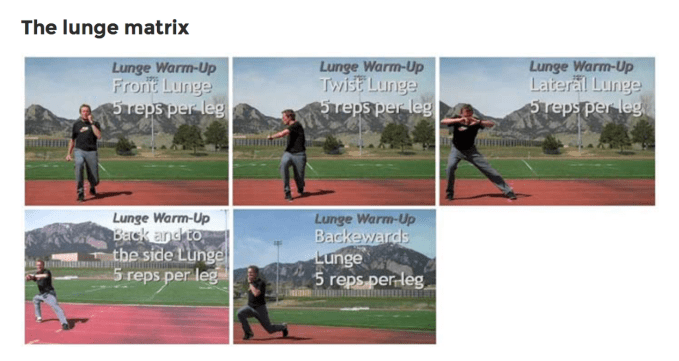
Lunge Matrix
Leg Swings
Long Runs
:60 Wall Sit & :60 Plank (Yes right after your long run – performing these exercises on tired legs and a tired core makes it all that much more BADDA$$! 🙂
Legs Up the Wall (5-15 minutes)
Roll – If you are not sure the best way to roll check out the video below!
Active Recovery – Short easy run (2-3 miles EASY), walk, swim (I know it’s kinda cold for this right now…), bike ride, play in the yard (or snow) with your kids!
Hip Hurdles: The video below uses a hurdle as a prop to swing you leg over, but the prop is not necessary. You can use a chair, the side of your bed, anything that you can reach up and around. If you are out on the road getting ready to run, you can just “pretend” there is a hurdle there. Pull your leg up and over as high as you can to activate your hips and get them ready to move!
Lunge Matrix: The “Lunge Matrix” involves a variety of stimulating moves that require concentration, which is key to stimulating the brain. This means working muscles in all three planes of movement – forwards & backwards (sagittal plane), sideways (frontal plane) and rotational (transverse plane). The Lunge Matrix does this. Since it is the first thing you are going to do before anything else, it is important that you start with small dip “baby” lunges until you feel the body beginning to warm-up. Once you do feel warmer and the knees are ready to flex to 90 degrees, ten lunges for each of the five versions below is generally sufficient.
Leg Swings: So simple and so effective. These are dynamic warm up moves you should never leave out of your warm up.
Leg Swings – Forward, backward and sideways
GO RUN! 🙂
Post Run: :60 Wall Sit & :60 Plank
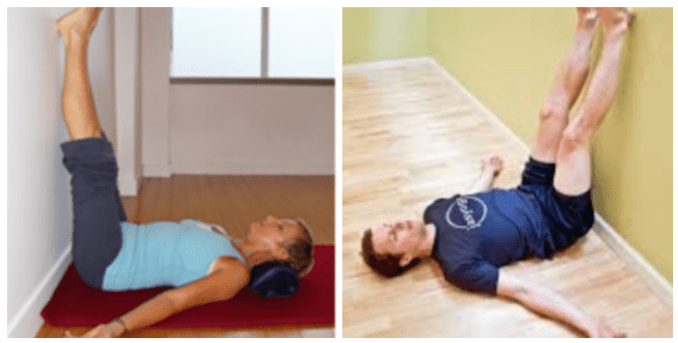
Legs Up the Wall: The best thing about this recovery move is its ease. All you have to do is find a wall, lie perpendicular with your butt up against that wall, extend your legs up, open your arms out to the side, and relax. No fancy equipment necessary. You don’t even have to do it for long, 5 – 15 minutes at most.
The pose helps reverse the typical actions that happen in our lower bodies as we sit and stand all day, and it’s especially useful right after a workout. It’s best to do this move as soon as you can after a workout (within 30 minutes) because having your legs warmed up and your veins dilated will make circulation to the rest of your body easier. In essence, this inverted pose aids your overall recovery by draining fluids that are pooling in your legs, while also stretching your hamstrings and relieving a worn out lower body.
Throwing your legs up a wall creates a positive circular flow to your core. Circulation matters when it comes to recovery because lactic acid and waste don’t leave your body very quickly and being in an inverted position helps it to drain faster.
Here’s how to do it: Lie down on your back and try to get your butt as close to the wall as possible, extending your legs up, perpendicular to the floor. Open your arms to the sides, palms up. Flex your feet for an added hamstring stretch. If that’s too uncomfortable, you can scoot away a bit so your legs are at an easier angle.
You’ll reap the benefits holding this position anywhere from 5 to 15 minutes. Start out small with 5-8 minutes and work your way to holding it for longer. The hardest part about this move is making the time and letting your mind relax when you have lots of other things to get to. And let’s face it, you just spent lots of time running and we all have other things to do.
You should notice less soreness and tightness after your harder runs and workouts and discovering a way to have a less creaky neck and better posture are also a nice added benefits.
Yes fellas, this move is for you too. We will all benefit from adding this to our routine regularly. Give it a try!
Rolling and Stretching: Last but certainly not least, and for most of us VERY important…roll and stretch! As we inch closer to the weekend, now is the time to take a few extra minutes with your roller then stretching out those limbs. You know how to do it, but if you need a reminder below is a great video to show you the most important areas to roll and the best order to do it in. Oh….and here’s a link to our 7 Key Stretches for Runners! 🙂
That’s all for now. I know it was a lot but I hope you got some good info out of this and I hope you make a little extra time this weekend for pre-run warm up and post run recovery!
Runners would rather lace up their shoes and spend time out on the road or a trail than do crunches and burpees. There’s a whole world of routes to explore when you are out on a run, and none of them pass through a weight room. We didn’t become runners to spend more time indoors…right?
More likely than not, you’re focusing more on strength now because you realize that doing nothing but running is not working out all that well for you.
Maybe you realized this because you’ve been forced to take time off from running due to an injury. Maybe it’s because you want to log faster miles and you’ve been doing everything…everything but strength training. Maybe you’ve decided you want to run more miles; you’re first half marathon or your first marathon.
Estimates of the rate of injury for runners vary depending on what you read, but some sources say injury rates for runners can be as high as 80% in a given year and each individual runner has an 80% chance of injury over the course of his or her lifetime.
80%!
Despite the stats, the sport of running has never been proven to be dangerous, but as we continue to pound pavement without getting stronger our body breaks down. Our bones and joints get weaker so our stride is off. Our hips get misaligned and drop, shooting pain down our legs, causing IT Band pain, knee pain, calf pain, and tight tendons. Our back and shoulders slump because our core is weak, which means more pain and more injuries. We love to show off our strong runner legs, but the rest of our body is tired and achy.
People will continue to run. Our friends run. Our neighbors run. We get jealous when you see others out on the road and we are sidelined because of an injury.
Jay Dicharry, a physical therapist and strength and conditioning specialist at the University of Virginia, calls running “a crazy type of badge-of-courage sport in which you have to pound yourself into shape day-in and day-out until you emerge on top.”
In the article, Strength Training For Runners: How To Do It Right, Dicharry points to several well-documented studies showing that strength training is tremendously beneficial for running in ways that decrease injury risk and improve performance.
He tells runners, “Get in the weight room. It is hugely important for runners to lift.”
I know it’s not fun. I know it hurts. I know you’d rather be running…but a few minutes each day spent on strength training will keep you on the road, it will keep you running longer, stronger and faster.
It’s been a tough week. I know you’re sore but that soreness you feel is your muscles getting stronger. Embrace the soreness…because it is so satisfying.
Day 5 exercises: 3 sets of 10 (“how to” videos are below)
Push ups
Medicine Ball Pass (Stability Ball – Hand to Feet Pass
Oblique Crunches
Russian Twist
Superman
Plank (:60 x 2)
Bonus: Roll & Stretch! This should already be a staple of your workout but if it’s not…do it today! It’s almost time to go long…love your calves, your quads, your hamstrings, your glutes, your back…love them now so they will love you on the road.
Push Ups: Just a reminder…or in case you’ve been living under a rock this week. 😉
Medicine Ball Pass (Stability Ball Pass – Hand to Feet or V-Pass): This is a tough exercise but it is a GOOOOOD one. The V-Pass promotes core strength and stability. Keep it slow and controlled, do not rush through this move. If you don’t have a stability ball, you can still do it. Grab a small ball or pillow and do your best! You will feel this move in your entire core.
Oblique Crunches: One important muscle that we train with obliquefocused exercises is the quadratus lumborum a muscle deep in the spine. When this muscle is weak, it places extra stress on the lower back and makes us more susceptible to back pain and injury.
Russian Twists: One of my favorite exercises. You can do this with or without weights. If you’ve never done it before, start without weights. You can keep your feet lightly on the floor, or raise them off the floor to make it more difficult. Either way, engage your core the entire time.
Superman: Core strength and flexibility…watch Michelle Trapp show us how it’s done.
Planks: We do them all the time. Hope you’re not hating them too much because they are so very good for us. Again, if you are a beginner take your time and work into these. If you cannot hold the plank for :60 take a short break then go right back into it.
As runners, we don’t give much thought to training our arms. After all, it’s the lower body that’s doing all the work, right?
Partially, yes. Our arms aren’t driving this bus, our hips and glutes are! The driving forces in our running come primarily from the muscles of the lower extremity and our core. However, if we are weak in our upper body, there is an imbalance of strength, and we won’t be as efficient.
The way we hold and swing our arms can tell us things about our running. It can also tell us how we can improve.
Here are three ways you might be using your arms and therefore not running efficiently:
Your Arms Wing Out from Your Body – This is a sign that you have weaknesses in your abs or glutes, because the arms have to go farther from the body to maintain balance. What this means you need to add to your training: more planks!
You Clench or Hunch Your Shoulders, Tightly Bend Your Elbows, or Cross Your Hands in Front of Your Body – These are signs of tension and wasted energy. You want your arms and shoulders to be relaxed with your elbows should be bent at about a 90-degree angle, with hands gently brushing by where your front jeans pockets would be. You want to cup your hands so that the thumbs rest lightly against the first two fingers, as if you’re holding potato chips but don’t want to crush them. Think of having a penny in your hand that you want to be able to move around, but not fall out. Your arms should arc slightly as they come forward, but should not cross your body’s midline. If you’re arms are crossing, you need to practice your arm swing so you’re relaxing more and keeping your arms from crossing in front of your body.
You Arms Have Different Movements or Ranges of Motions – This is a clear sign of muscle imbalance…in your hips & glutes! If you have a different range of motion in one arm verses the other, your push-off is weaker on one side. Practice focusing attention on squeezing your glute muscles as you push off each foot to propel yourself forward. If possible, have someone film you from behind while you’re running so you can then watch where your arms travel when you’re in action. This is a great way to see what your form really looks like when you’re running.
When Arm Swing Matters the Most – There is one time in a runner’s repertoire that a powerful arm swing may make a difference: in a sprint, typically at the end of a race. The arms account for about two to three percent of the forward velocity in a sprint. By pumping your arms on that final stretch when your legs are fatigued, you could make the difference between a good race and personal record!
Arm swing is very important, but if our arms are weak, we’re missing out on a lot of power that can help us push forward when our legs are tired.
A strong upper body provides runners with the following benefits: Naturally, strong leg muscles are crucial for running fast, but many runners underestimate the importance of upper body strength for efficient running performance. A strong upper body Arms, shoulders and back and core) is essential for guaranteeing an efficient transfer of energy from your body to your legs. Without this, even the proper arm technique cannot provide optimal support to your legs. An efficient running form helps you to run faster and expend less energy, meaning that running faster takes less effort.
An additional benefit: Well-developed arms, shoulders, abs and back muscles help protect our spine from the impact of running. Thus, a strong upper body is essential for minimizing the risk of injury. The best exercises for building up your stabilizing muscles are total body exercises like planks, push-ups and burpees!
We all love to run. That’s why we’re here right? And while all we really want to do is go out and run…in oder to stay on the road running longer, stronger, and without pain we have to do the little things that prepare our body to go the distance. So today…it’s all about our arms!
Little known fact: When we think about arm work, we’re mostly drawn to bicep work. And while it’s important to have strong biceps, the real benefit for runners comes from having strong tricep! When we run we push our arms backwards, which propels us forwards. This power comes from our triceps. So today, we work that often flabby part at the back of our arms where we need the most strength. And the upside…bye bye bat wings! 🙂
Day 4 exercises: 3 sets of 15 (how to videos at bottom of page)
:60 Plank
Push Ups
Tricep Dips
Tricep Overhead Extensions
Tricep Kickbacks
:60 Plank
Bonus: Burpees – Burpees are fabulous full body exercises that we all love to hate! Don’t worry, we aren’t doing a lot of them… 1 set of 10 and you are good to go! Not sure how to do a burpee? Check out this video on burpees for beginners. No jumping! Just start in the up position with your hands in the air, come down to a squat position, put one foot back at a time, then reverse the process. One set of 10. You got this!
Burpees are one of the most effective and powerful full body exercises that an individual can do. They require no special equipment, gadgets or gimmicks to perform. They can be done almost anywhere and anytime. A few minutes of burpee conditioning will quickly show you that your own natural bodyweight provides plenty of resistance for an amazing workout that builds your stamina and explodes fat burning through the roof!
Speed Work: If you haven’t gotten in your speed work yet this week, today is probably the last day to do it, unless you are doing long on Saturday, then you’ve already missed your window. If you’re going long on Sunday, DO YOUR SPEED WORK TODAY! 🙂
Click here for Monday’s post and scroll down for this week’s workout!
As always…roll and stretch! Long runs are coming soon! Love those legs so they are ready to give you all they’ve got! 🙂
Push Ups: Hopefully you are getting used to having these in your regular routine. A few more per set today…you can do this!
Tricep Dips: You can do it from a chair or a bench, you can even do it on the floor.
Tricep Overhead Extensions: Working the triceps again here. Don’t use a dumbbell that is too heavy. Keep your elbows in close to your ears. Watch Michelle Trapp (one of my favorites) show us how it’s done.
Tricep Kickbacks: You can use the edge of your bed, couch or a chair if you don’t have a bench. Your arms will be starting to get sore by now. Push through it Crew!
Plank: If you are new to planking, please start slowly and work your way up. If you can’t hold the plank for :60 break it into :30 with a short break in between.
The plank is a great core exercise that doesn’t involve doing any crunches. In fact, the basic plank doesn’t involve moving at all. This is referred to as an isometric exercise.
Here is a great beginner video for planks. Watch and see how it’s done properly to get the most out of this exercise and to avoid getting hurt.
If you’ve been with us for a while, you’ve heard me go on and on about the importance of hip and glute strength for runners, but since we have a lot of new Crew members, we should probably go over it again. 🙂
Our hips play a major role in keeping us healthy. Numerous scientific research studies have proven that runners routinely suffer from weak, tight, and under-developed hip & glute muscles.
These hip muscle groups are particularly important because they’ve been implicated in a large range of running injuries. Weak hips can often be the cause of IT band pain, patella tendonitis (runner’s knee), piriformis issues, sciatica, and a myriad of other common running injuries.
I found out first hand how weak my hips were in late 2016 when I ran the Chicago Marathon. Truth be told, it started MUCH earlier than that. I had been suffering from knee pain for a long time, years really. I went to doctor after doctor, had numerous x-rays and 2 MRIs but each time the docs told me I was fine. There was nothing wrong with my knee. SO FRUSTRATING! I mean come on…I knew I wasn’t imagining the pain!
I kept running of course because that’s what we do. We push through the pain…especially when doctors are telling us there is nothing wrong. I got a cortisone shot a few weeks before the Chicago Marathon and that helped NONE. I was fine through the early miles of the race but around mile 18, like clockwork, I started having stabbing pain in my left knee. Holding back tears, I kept running/walking and watched my pace slow a lot. I was doing more walking by then and I just couldn’t keep the pace needed to hit the time I wanted. I watched that PR fade away with each mile. I finished. I cried (I pretty much always cry when I finish a marathon). I did get a PR…by about 3 minutes, and I was happy about that. But I was very ready for a much faster time so the disappointment was still there. My lungs and my legs could handle the pace….but the pain in my knee held me back.
When I got home I called an orthopedic that was recommended to me and was able to get in pretty quickly. He looked at my past MRIs and said the same thing every other doctor told me. “Your knee is fine. There is nothing wrong with it.” UGGGHHHHH!!
Thankfully, he did not stop there. He did not make me feel, once again, like I was delusional and making up the pain. He said that my knee was fine…it was my hips that were the problem.
HUH?
“Your hips & glutes are weak. When those areas are not strong enough to sustain the weight of your body pounding into the pavement for so long, it shoots pain down into other areas.” For me…it was my left knee.
He gave me some strengthening exercises to do like clams, side lying leg lifts, bridges, Hip lifts, leg swings, etc… I started doing them right away and also incorporated them into our #CoreCrew calendar. No joke y’all…I DO NOT have knee pain anymore. In fact within about 2 months of the strength training I had ZERO knee pain. YAY!! Finally someone was able to explain to me what was wrong and how I could fix it.
My hips did not lie and the Orthopedic was right. All that money spent on doctor visits, X-rays and MRIs, and all I needed was some basic strength exercises to help me run pain free!
This was all in late 2016. Throughout the summer of 2017, I trained for the New York Marathon. I ran a 4:35 in October 2016 in Chicago….and one year later in November 2017, I ran a 4:05:22 at the New York Marathon and I did it pain free! I won’t say that it didn’t hurt or that it was easy…it was still a marathon. But the dreaded knee pain never came. Not at mile 18, 20, 24 or 26. Yes, I cried when I crossed the finish line…but that’s nothing new. 🙂
Your hips don’t lie either. Are they trying to tell you something?
Day 2 exercises: 3 sets of 10 (see “how to” videos at bottom of post)
Bridge
Weighted Hip Lifts
Clams with Resistance Band (if you don’t have a resistance band that’s ok do it without the band)
Reverse Clams
Push Ups (3 x 10)
Wall Sit (:60 x 2)
Day 2 Bonus: Side Lying Leg Lifts (3 x 10) – This exercise is designed to strengthen our glutes and shape our derriere. In addition to working your glutes, this does wonders for your core, as well. Make sure you are holding your core tight while you’re performing this move!
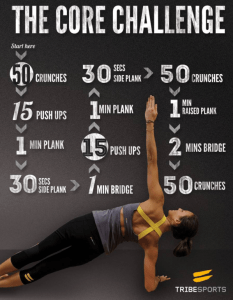
Day 3: Quick Workout – The Core Challenge: Everyone really liked this workout last week and it fired up our core in a good way so let’s do it again on Wednesday! If you are new to planks, just do the best you can. I promise you will get better at them!
Speed Work: This week’s speed work is the “Even Steven” workout. You can find the details in our Monday post. Click here and scroll down to find out how to make it happen! I didn’t talk about “when” to do speed work in yesterday’s post, but they best days to do speed work are opposite days from your long runs. So if you do long runs on Saturday, Tuesday or Wednesday are your best options. If you go long on Sunday, Wednesday or Thursday are your best options. If you don’t give yourself enough time after your speed work to recover, your next long run will suffer. If you don’t give yourself enough time after your long run to recover, your speed work will suffer. Resting is important. “Rest” doesn’t always mean no running….but it does mean a nice and easy pace. That easy pace allows your legs and your lungs to take a break from the tough work.
Day 2 “how to” videos: All of the exercises for today are listed below. Please watch how to do them correctly to avoid getting hurt or and to avoid doing all this work for nothing…
Bridge: The bridge exercise strengthens the whole abdominal region, the lower back and the glutes.
Weighted Hip Lifts: This is one of my favorite exercises and it is very similar to the bridge except you’re resting your body on a bench, chair, sofa or bed. Adding a weight will help you build stability and strength. Go slow and don’t add too much weight. If you don’t have a dumbbell you can use, try a medicine ball or anything sort that has some weight to it.
Clams with Resistance Band: The band resisted clam shell exercise is great for strengthening and mobilizing the external hip rotators. This exercise strengthens and supports our knees so that we can decrease knee stress.
Reverse Clams: Keep some space between your knees and keep your body straight not arched. Great how to video here with common mistakes!
Push Ups: Same how to video from yesterday. Push ups from your knees or against the wall are OKAY! Work from where you are now don’t try to do more than you are ready for!
Wall Sit: Again, same video from yesterday because I really like how she explains how to do this exercise and why it’s so good for us. You will see A LOT of wall sit in your future with the #CoreCrew so I hope you learn to love them! 🙂
Nothing good comes from sitting around doing nothing so it’s time to get up and get moving! Remember…it’s the little things that count and today…it’s all about moving those legs!
Trust the yourself, trust the process, trust your legs today…and take the leap into 2018 with a BIG leg day Crew!
Day 1 exercises: 3 sets of 20 (“how to” videos at the bottom of the page)
Squats
Sumo Squats
Curtsy Squats
Squat Hold :20 each round
Push Ups (3 x 10)
Wall Sit :30 x 3
If you’ve had a chance to look over the January Challenge calendar you’ll see that push ups are often on the schedule this month. The reason for that is because we have a push up challenge on the last day of January and I want to get you ready for it!
At the end of a long race, our arms are our secret weapon. Using our arms for momentum is what powers us to the finish line when we are tired and feel like we can’t take another step. In order for them to hold that power, we need to work them just like our legs! So this month….push up challenge o the 31st. And there might just be a prize! 🙂
Speed Work: When you’re first getting moving, it’s important to just focus on getting into the exercise habit; making your run or walk a regular part of each day, finding times and places to exercise that feel convenient and comfortable, and finding a way to enjoy it so you keep it up for the long term.
As you progress as a runner you may start to wonder, how can I get fitter and faster? You could add time to your workout, or increase the distance you cover. Another approach is to add some structured workouts to your routine. These workouts, which involve running specific intervals or time or distance at a specific pace, can help you develop endurance, speed, and stronger legs and lungs. And, it can keep your exercise regime from getting stale.
Yes you read that right, speed work is NOT just for getting faster. Speed work sessions help you build up endurance which makes our long run easier, it builds your lung strength or VO2 Max which allows your body to process oxygen more efficiently. Of course, it can also help you get faster and stronger too. Speed work can be scary, but once you try it a few times, it gets easier….or maybe you just get stronger! 🙂
Workout – The Even Steven:
Walk for a few minutes then go into a jog for 1 – 2 miles to warm up. After your warm up you will go into mile repeats. I know this sounds horrible but it’s really not that bad because you want your pace to be “even steven” not all out at any point.
Depending on the number of mile repeats you do, you need to start at a conservative pace (but faster than your easy pace) so you can run each mile repeat at the same pace, or within five seconds faster or slower than the previous mile.
WHAT IT DOES: This workout builds endurance and teaches you to maintain a steady, consistent effort, which is what you’ll want to do in your race. “Runners of all abilities tend to just start running as fast as they can, until they tire out and have to quit,” says Paul. Knowing that you have a few miles to do, you’ll learn to start your first mile slower and get into a rhythm that you can maintain for each mile.
How many of these mile repeats should you do? That depends on the distance you’re training for and your current fitness level. If you’re a beginner, do a 1 mile warm up, 1 mile even steven, then a 1 mile cool down run/walk. Well into training for a 5K? Add another repeat in the middle and go for 2 miles so 4 miles total. Yes, when training for a 5K you should train to run longer than the 5K distance. See the list below for more distance options for this speed workout. I am here if you have questions about pace or the workout so don’t hesitate to reach out to me!
Beginner 5K: 1 mile warm up + 1 mile repeat at a slightly faster pace + 1 mile cool down = 3 miles (mile repeats @ 5K pace)
5K: 1 mile warm up + 2 mile repeats + 1 mile cool down = 4 miles (mile repeats @ 5K pace)
10K: 1-1.5 mile warm up + 3 mile repeats + 1 mile cool down = 5-5.5 miles (mile repeats @ 5K pace)
Half Marathon: 2 mile warm up + 4-5 mile repeats + 1-2 mile cool down = 7-9 miles (mile repeats @ 10K pace)
Marathon: 2 mile warm up + 5-6 mile repeats + 2 mile cool down = 9-10 miles (mile repeats at Half Marathon pace)
I have added “pace” to each workout. This is relative to where you are in your fitness. If you are confused, please reach out to me! Remember, DO NOT go all out on this workout. You want even steven for each of the miles in the middle and if you go out too fast, you won’t be able to hold those later miles. The goal of this workout is to finish the entire workout with your mile repeats within 5-10 seconds of each other.
Pre-Hab: When you’re done with your workout, it’s time to love your legs! Rolling and stretching is a big part of our maintenance and it adding it to your routine on a regular basis will make a difference in your running, your pain level, and the overall health and fitness of your body. I know it hurts, I know it takes extra time, but I promise it will help you feel better, keep injuries at bay, and get you moving quicker again after workouts.
First we roll. We roll fist to get the kinks out and lengthen our muscles. Then we stretch. A the link to our stretches for runners. is below. It’s actually 8 because we added the pigeon pose which we all really love. All of this stretches have a purpose. Get to know them and love them!
That’s all for today Crew. Plan ahead to get your speed work in, and leap into 2018 with a positive attitude and a commitment to do the little things that come together and make life big!
Day 1 “how to” videos:
Squat: We squat all the time – doing yard work, picking things up off the ground and just the movement that comes along with sitting. Squats also help us build strength in our hips, quads, hamstrings and calves. Building strength in your legs by adding the squat to your exercise routine is a smart way to help prevent injuries while doing your everyday activities.
Sumo Squats: You don’t have to have a dumbbell to perform this exercise but it might help keep you stabilized and balanced. If you use a dumbbell hold one in both hands and use it to balance in the middle as you sit backwards into your squat. Make sure you are putting your weight into your heels not your toes.
Curtsey Squat: Great exercise for hip mobility, balance & glute strength. Our glutes are what pushes up as we run so we need them strong and able to propel our body forward!
Squat Hold: This is going to burn after doing a few sets of the previous squats but that is ok it’s not supposed to be easy! Lower into the squat hold position and stay there for :20 before coming back up and moving on to the next exercise.
Push Ups: Push Ups are one of the most effective body weight exercises we an do to build strength in our core and upper body! This video will show you how to do push ups for beginners and how to progress as you get stronger.
Wall Sit: The wall sit is a great exercise to target the entire thigh area, your quad, your inner thigh, the back of the leg, the hamstring, and your gluts. You’re just going to find a wall. You’re going to come into a squat position. Your feet are going to be out. Your knees are aligned with your ankles, and you’re going to push your weight back into the wall here. You want to make sure that you’re digging through your heels as you’re in your squat position and that your legs are 90 degrees.
It’s the middle of the week and time to fire up that rump! The next two days are dedicated to strengthening our glutes and hips. You know you love it!
Quick & effective….no excuses why you can’t get these workouts done. 12 minutes today and maybe 8 minutes tomorrow. Feel the burn and the positive effects of strength work! 🙂
Day 20 exercises: Donkey Kick Workout – I know y’all love to hate this workout. Let’s do it!
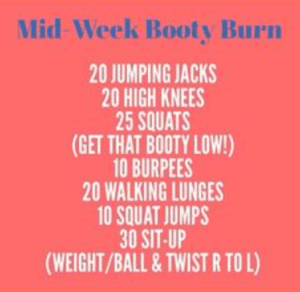
Day 21: Mid Week Booty Burn – After the Donkey Kick Workout on Wednesday, you should definitely feel these squats and burpees. Don’t worry, it’s only a few of each to fire up that rump again! 🙂
Speed Work: Structured Fartleks – If you didn’t race last weekend, and don’t have a race coming up this weekend…you should be making time for speed work! Below is a link to the post with this week’s workout in case you missed it…or are just trying to get out of it. 😉
Think back to your first race, your first 5K, or maybe the first time you went bigger and signed up for your first half or full marathon. As race day got closer, you were nervous, but excited. You drove to the race site full of hope and determination.
The gun went off and the race started….you did really well through the first half but then it got ugly. You slowed down, but you pushed through. It hurt, but you didn’t quit. You’re probably remembering tears of relief and happiness. A feeling of contentment and absolute power in being able to finish what you started.
It wasn’t so much the race as it was all of the work you put into that moment. It reminded you that you’re tougher than you think you are. That when you put your mind to something, you can achieve it. It was an amazing feeling and you were hooked!
You didn’t quit halfway, you didn’t stop when you got tired or your mind was telling you you couldn’t do it. You pushed through. YOU FINISHED!
Time to put that grit, that resolve to finish what you started, to the test. This is one of the busiest times of the year. So many people pulling you in different directions, vying for your time and attention. But you made a commitment to yourself. And it’s time to finish it!
The 2nd half of your race is here. You didn’t quit before…no way are you going to quit now!
Day 18 exercises: Nike’s Strength Workout for Runners – You’ve been working on this each Monday and you’re getting better at it. Let’s do it again! 15 minutes and you’re done!
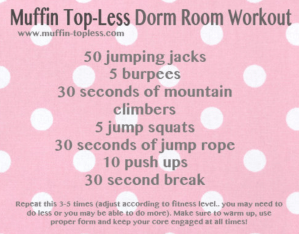
Day 19 exercises: Muffin Top-Less Dorm Room Workout – We’re not dorm dwellers, but sometimes we can feel the pressure of crunch time weighing down on us and we need a quick workout to give us energy and get us mentally prepared to face the busy day ahead! 3-5 rounds of this workout will have you feeling calm and ready for whatever comes your way.
Speed Work: Structured Fartleks – Fartlek is a swedish term that means speed play. So this week we are turning our intervals upside side and playing with speed in a different way, by ushing HARD through that normal “rest” period and taking the longer interval as recovery. What does this mean?
We’re going to run fast for :30 – :60 then walk and let our heart rate drop for the same amount of time. But these faster run segments aren’t just a little faster. They are at push pace, with you giving it 90% of your maximum effort! Think a full minute faster than your 5K pace. So it you run a 30 minute 5K and your average pace is 9:40/mile, then these short run clips should be at a 8:40/mile. Same goes if you run a 40 min 5K and your average pace is 12:55/mile. Then these short run clips should be at 11:55/mile. Whatever your most recent 5K run or race was, use that average to determine your pace for this workout.
This is a great workout for the road so no need for a track. Set whatever timer you use or the intervals on your watch for :30 – :60 run and the same :30 – :60 walk. I know each and every one of you better than you think…if you’re capable of :60 run clips, don’t sell yourself short…
Total workout should include 1-2 mile warm up + 2-4 miles of fartleks using the above scenario + 1-2 mile cool down. Total of 3-8 miles depending on your level of fitness. This is a simple workout that you can squeeze in on this busy week before Christmas! Just set your intervals and go!
We’re busy… We’re stressed…. We’re tired…. but all those things are just the negatives that are keeping us in our comfort zone. It’s easy to stay comfortable. But nothing incredible every happens inside our comfort zone.


















 Strong to the Core