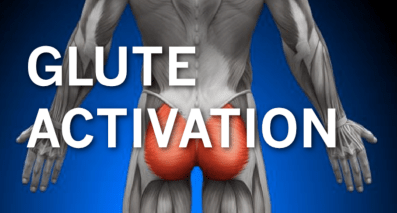
A few quotes from Doctors and Physical Therapists on the importance of glute strength…
“Glute strength is very important because it controls the entire lower leg and provides stability. If there is no stability, your legs can’t generate power. If you have weakness, other parts of your body try to provide stability and therefor you will have compensation and poor mechanics.”
“Gluteus maximus gets a lot of attention for the force it generates during push off and for good reason. We also know it’s an important muscle in maintaining proper trunk posture while running, as well as controls deceleration of the hip prior to foot strike.”
“Glute strength helps stabilize your pelvis as well as your knees. It prevents issues like Patellofemoral syndrome and IT band syndrome, both common in runners, as well as achilles tendonitis. We need our glutes and hamstrings to help with hip extension as well and shock absorption. Without them we rely to much on the wrong muscles which leads to problems. Our daily activities do not naturally work the glutes and hamstrings so we have to put more of a focus on them.”
Why are our glutes so weak?
In Eat, Move, Sleep, Tom Rath talks about how our sedentary lifestyles may be affecting our overall health, not to mention glute strength. Sitting all day is bad! Several other sources say the same.
Researchers have found that “those with sedentary behavior have 49% greater risk of dying prematurely — even if they regularly exercised.”
According to Strengthrunning.com, “After awhile of sitting down, your muscles remember the position that you put them in. Your hip flexors get tighter. Your glute muscles stretch out and get weak. It’s bad news – so avoid prolonged sitting (or standing) as much as you can”
Our amount of time spent running each week, doesn’t come close to the amount of time spent sitting, especially for those who have office jobs and tend to sit most of the day. As a result, our glute muscles aren’t needed as much, making them weaker. When you sit all day, your butt gets stretched out, making it more difficult to contract.
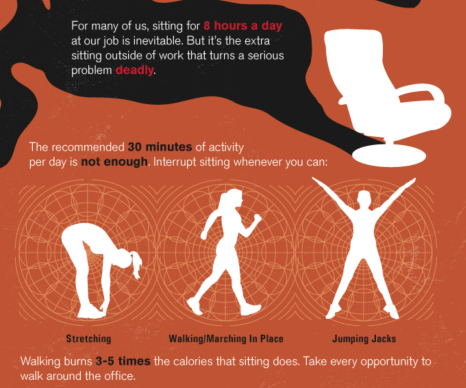
This awesome infographic says it best. Below is a small piece from the infographic. If you are one of those millions of people who’s job requires them to sit for long hours, you’re at an even higher risk for weak glutes. Please make sure you take a few minutes each hour to get up and move around. Do some stretching, walk in place or jumping jacks. Every extra little bit of movement counts!
On to the show….
Day 13 exercises: 2-3 sets of 10
Donkey Kicks
Fire Hydrants
Bridge with Leg Lift (slow this one down)
:60 Wall Sit
Bonus: If you’ve been with us for a while, you probably already know what’s coming… Yep…the Donkey Kick Workout! Tough but doable. Fire up those glutes Crew! 🙂
Extra Credit: Our 7 Key Stretches for Runners should be done daily, or at least after every run, but if making it our “extra credit” works then I will add it everyday! 😉
Speed Work: Mile Repeats are on the menu this week. Click here and scroll through Monday’s post to find the workout.
Tuesday June 13th “how to” videos:
Donkey Kicks: Targeting your Glutes and Lower Back, this movement also helps strengthen your core.
Fire Hydrant: Lock your elbows and abduct the hip at 90 or 45 degrees, draw your navel in and look at the ground.
Bridge with Leg Lift (Slowly): Work on control and stability
We’re gonna work it all today Crew! Let’s build strength in our arms, legs, and core, and throw in some cardio to get the juices flowing!
Keeping this short and sweet today, because I am heading out for a run and I can’t wait! Patience has paid off and my legs are feeling so good again…so it’s time to get back into the swing of things and pound some pavement! 🙂
Day 12 exercises:
Combat Burpee – 2-3 sets of 10
Burning Bridge – 2-3 sets of 10
Jump Rope (with or without a jump rope) – 100 total (2 sets of 50 or 4 sets of 25)
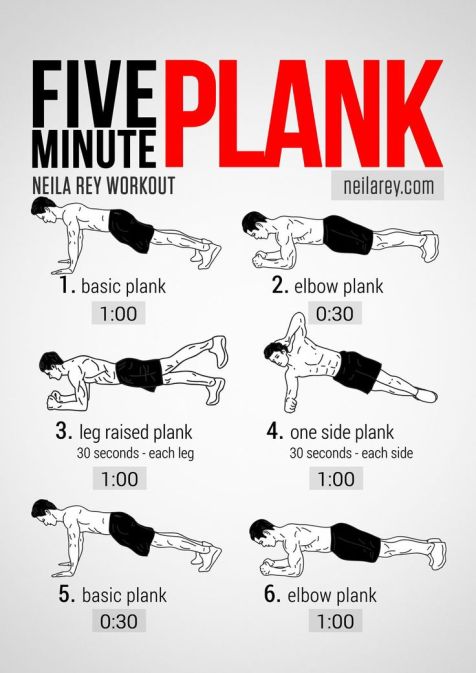
5 Minute Rolling Plank
Bonus: #OneExtraRound – It’s Monday and a great day to push yourself just a little bit farther. If you were going to do 2 sets…do 3! If you were going to do 3 sets…do 4! Show Monday who’s boss!
Extra Credit: :60 Wall Sit – If you are running today, finish off your run with a strong :60 Wall Sit! Do it before you even go inside. Find a wall or a car and take a minute to work those quads! The wall sit on tired legs is a great way to build strength!
Weekly Speed Work: Cranking it up a notch this week and letting our speed work stretch out. Mile repeats! Mile repeats can work wonders for 5K-10K runners, half marathoners and marathoners by manipulating the intensity, number of reps, recovery and even terrain to suit your needs. Mile repeats are long enough to build race-specific strength and endurance and challenging enough to help improve your mental game when doubt sets in and focus starts to fade.
The number of mile repeats you do depends on the race distance you are preparing for and the time you have until your next goal race. As always, you need to run a good mile to mile and a half warm up before you start your mile repeats then another mile to mile and a half cool down when you’re done. If you are less than a week and half out from your next race, don’t push yourself to far…it’s already time to be tapering and getting ready to race. 2 weeks or more out? – Go for it and see if you are ready to meet your goal.
5K: 3-4 x mile @ 5K pace or up to :20 slower with :90 rest in between miles
10K: 4-6 x mile @ 10K pace or up to :20 slower with :90 rest in between miles
Half Marathon & Marathon: 8-10 x mile – For this workout, try alternating your pace between half marathon to marathon pace every other mile. So for the even miles slow down about :30. – Rest 2-2:30 minutes between mile repeats.
PLEASE REACH OUT TO ME IF YOU NEED PACING GUIDELINES! I am here to help you. Please let me know if you have questions about the pace you should be trying to hit for this speed work. Done correctly, this workout can be a great indication of whether or not you are ready to hit your goal time.
Monday “how to” videos:
Combat Burpees – Fun variation on the traditional burpee! Give it a go!
Burning Bridge: Another great full body burn! Squeeze your glutes and keep your tight core while you work your arms!
Jump Rope: Don’t have a jump rope handy? No problem! Just pretend you do and get to jumping!
Five Minute Rolling Plank: Round it off with a strong 5 minute rolling plank! This will work every part of our body and you can do this so give it a go and surprise yourself with how much strength you have!
What separates professional runners from the rest of the pack? In addition to running, drills, and strength training each day, elite runners will often spend 1-4 hours per day on recovery!
Long runs are essential to our training because they enable our body to adapt to running longer distances more safely and efficiently. Unfortunately, more miles also increases our risk of injury, which can result in unplanned—and unwelcome—time off.
According to Runner’s World, “one simple way to offset the risks inherent to long bouts of running is cold-water immersion, known to many runners as the ice bath.”
Cryotherapy (“cold therapy”) constricts blood vessels and decreases metabolic activity, which reduces swelling and tissue breakdown. Once the skin is no longer in contact with the cold source, the underlying tissues warm up, causing a return of faster blood flow, which helps return the byproducts of cellular breakdown to the lymph system for efficient recycling by the body. Ice baths don’t only suppress inflammation, but help to flush harmful metabolic debris out of your muscles. You could use individual ice packs, but cold-water immersion produces a greater and longer lasting change in deep tissues and is more a more efficient means of cooling large groups of muscles simultaneously.
After our long runs, we want to reward ourselves with a hot shower and a hot meal, so the thought of sitting in a tub full of ice water has us running the other way screaming. But if you can get passed the horrific thought of submerging yourself in freezing water and just jump on in, your muscles, ligaments, and joints will thank you later.
How exactly do we go about this cold therapy thing? Well there are a few things you should do first.
Immediately after our long run (within 10-15 minutes), we should be eating and hydrating. Our post run fuel could be something like chocolate milk, yogurt and granola, banana and peanut butter bagel with orange juice. You want to aim for a 4 to 1 ratio of carbohydrates to protein. Some athletes use glucose tablets (made for diabetics) directly after running. A pure glucose tablet stimulates the insulin response in the body and ignites the recovery process and is quick and dirty trick if you’re crunched for time or have a sensitive stomach and don’t feel like eating right after a tough workout.
Next up is stretching and rolling. Stretching should last 10-15 minutes, focusing on the major muscle groups (quads, hamstrings, calves, and hips) as well as anything that is nagging or felt sore on the run. Our 7 Key Stretches for Runners routine is the perfect way to loosed up all those important muscle groups. If you have a foam roller, next up is rolling your legs to to alleviate any knots and tightness.
Now it’s time to hit the ice bath. Fill your bath tub with cold water and add 2-3 bags of crushed ice. The ice should completely melt, but it should take about 3-5 minutes for a normal size ice cube to do so. The water should cover you nearly to your waist. Before getting in, put on a jacket or long sleeves and make myself a cup of hot tea, and grab some entertaining reading material to help the next 15 minutes pass quickly. The more you ice bath, the more comfortable this process becomes. After letting all the water drain from the tub, go ahead and take your shower. Your legs will feel cold for a few hours, but your muscles will thank you later.
After the ice bath, you’ll want to ensure that you get a well-balanced meal in your system. So far, you’ve had some chocolate milk, Gatorade, and some light snacks. To completely refuel, your muscles need something more substantial. If you run in the morning, this could be breakfast – eggs with veggies and whole wheat toast, oatmeal with fruit and toast, or pancakes are a decent choice if you top with fruit and yogurt. Lunch or dinner could be salad with a sandwich, pasta, or leftovers from the night before. You just want to consume a high quality meal with a good balance of carbohydrates, proteins and fats. This will provide your body with the final nutrients it needs to top off the recovery process.
Take a nap or get a massage – what a luxury! After your meal, put your feet up, take a nap, and if you’re really snazzy, follow it up with a massage. This is where things can get “ridiculous”, as massages and naps are a fantasy and extreme luxury, but in the perfect world, this is the “optimal” way to recover and a nice treat too.
About an hour or so before you fall into bed that evening, you should take a warm/hot bath in Epsom salts. Combine 4 cups Epsom salt with 1 cup baking soda and relax in the hot water for 10-15 minutes. After the bath, dry off and roll out your muscles again and get in another good 10 minute stretching session. Not only with this help remove excess toxins from the muscles, the stretching before bed will ensure that you wake up feeling ready to go for your next run. Furthermore, the relaxing bath and the Epsom salts will help you sleep.
Here’s a quicker list to summarize and one you can screen shot or right down for future recall:
Hydrate as soon after your run as possible with Gatorade or electrolyte drink
Eat a small meal that contains a 4 to 1 ratio of carbohydrates to protein
Stretch major muscle groups and anything that is sore or tight. Roll out any nagging injuries or problem areas.
Take an ice bath
Eat a decent sized, healthy meal
Nap, put your feet up, or get a massage
Take an Epsom salt bath
Roll out on the stick and stretch well
Get plenty of sleep
This routine is quite extensive and you won’t always have the time to get it all in. You should make time for at least 1-3, followed up by 5 & 7-9. On those rare occasions when you can fit it all in you will feel like royalty and be ready to go for next hard workout.
The day after your long run it’s time for active recovery; short easy run, yoga, stretching, swim, bike, long walk. You have lots of options, just make sure you’re not sitting around being ideal and causing your muscles to stiffen up.
Here’s what’s on tap for the weekend. Don’t forget your post long run wall sit and plank!
Bonus: Active weekend selfies – We want to see you being active so you’re only weekend bonus is to capture yourself and your friends doing what you love! Share it with the Crew and tag your post with #ActiveWeekend. Who knows who you might inspire!
With lots to do and with family time and other fun stuff also on the list, it’s time to get moving and get it all done! That list of chores and other boring stuff can wait till Monday….Let’s have an active weekend Crew!
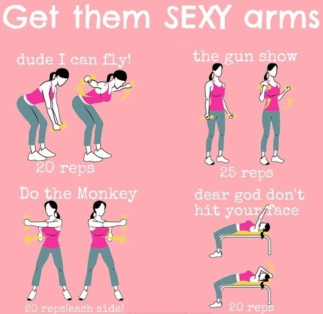
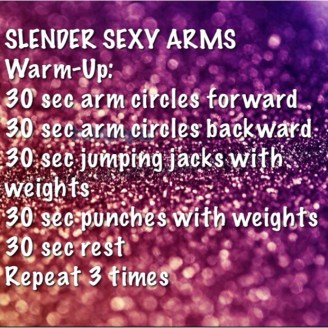
Today’s arm work is a quick at home workout that will help us tone, tighten, and strengthen our arms. It’s a simple routine that is fast, effective and will give you that good arm burn to go into the weekend knowing you made a huge effort towards your strength this week!
If you have different sized weights to choose from, switch up your weights for some of these moves. The fly and the “monkey” will be difficult with heavier weights, so go lighter for those. I will use my 5 lb weights for the fly and monkey and my 8 or 10 lb weights for the bicep curls and skull crushers.
Day 8 exercises: 1-2 full sets
Get Them Sexy Arms
:60 High Plank
Arm Stretches – Bicep Stretch & Tricep Stretch – Click here and scroll down for a reminder of these stretches from last week.
Bonus: #SlenderSexyArms
Since today’s routine is short, let’s add in a round or two of another one of my favorites. Who’s in?
It’s Friday and we’re gearing up for the weekend. I hope you have made your long runs plans! Remember that planning and preparation are so important in ensuring that everything goes well. You should be hydrating, planning healthy satisfying meals, stretching, and getting your gear ready. And of course you should be reaching out to your best running friends so you can pound some pavement together! We all know that running is better with friends!
Extra Credit: The bonus stretching worked well today as I saw a bunch more of you doing it so today’s extra credit is our Key Stretches for Runners. Treat yourself and muscles nicely with some extra stretching and rolling today!
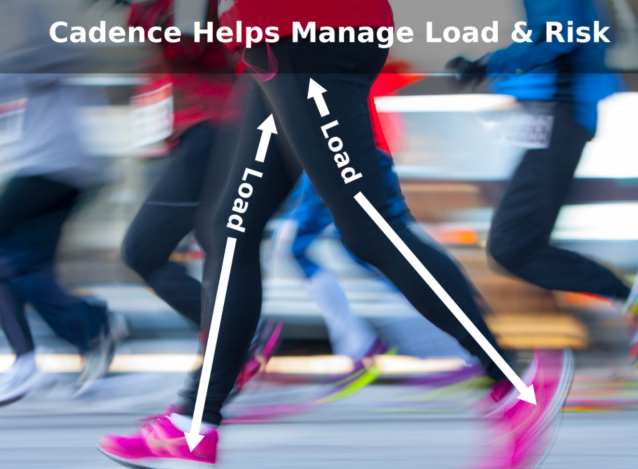
Physiologists have known for years that the two variables affecting running speed are stride length and stride rate (cadence). Arm swing and correct stance are important for developing a proper running gait, but the easiest way to improve your form, reduce the chance of injuries, and run faster is to focus on your cadence.
A runner with a quicker cadence generally leads a runner to land with their foot underneath them as opposed to out in front of them resulting in a shorter stride.
Runners with a longer stride generally extend their legs out on front of their body when they land, creating a breaking effect. This slows you down and can lead to injuries in the foot, calf, knees, and hips.
The correct cadence can vary by individual. Optimal cadence is generally considered to be somewhere around 180 strides per minute. 170 and higher is ideal, but ‘ideal’ is slightly different for each person.
The majority of elite runners strike the ground around 180 to 184 times each minute and their cadence (number of foot strikes) remains whether they are running a 5K or a marathon.
This consistent cadence can benefit efficiency by increasing running economy.
Running economy is all about how efficiently you use oxygen at a certain pace. The more efficient you are in using it, the better your running economy. Running cadence is inextricably linked to economy because it affects the way you strike the ground. Better form and optimal cadence translates into improved running economy and faster times.
There are two main reasons to focus on your cadence: to eliminate overstriding and to give you another weapon in your running arsenal. When you are feeling tired and feel like you have nothing left to give, you can focus on your cadence as a way to reset your mind and being your stride together. Counting your foot steps and getting them to that 180 per minute, can help you finish stronger and faster. The key is to lengthen it out the back side…not by reaching forward and extending your stride to the front. Using your glutes and hamstrings to create that propulsion will keep you from slamming on the brakes with each step, as often happens to runners who lengthen their stride out the front.
No two athletes are exactly the same and a lot of people have taken the Daniels suggested 180 step per minute as the “golden rule” of cadence but what he really said is to strive for 180 as a minimum. Many recreational runners strike between 150 and 155 times per minute, but once you have your number, you can begin working to improve it.
Retraining your cadence is easy to learn for most people. While it is next to impossible to adequately judge your form while you’re running, counting your strides. is simple. You can easily determine your own cadence by counting the number of times your left foot hits the ground whilst running for 30 seconds.
Let’s imagine yours was 40.
Double that to get the total for 60 seconds (80); then double it again to get the total for both feet (160).
Your cadence (for that particular running speed) is therefore 160spm.
There are several ways you can work on maximizing your cadence and stride length but it is important to change your cadence slowly using shorter distances. Start by adding short distances into your runs in which you try to maintain your new target. This can be done through use of a metronome if you’re running on a treadmill, or you can download a free app on your phone.
Counting steps is only one way to work on cadence. Others include:
Plyometrics: Explosive exercises like depth jumps and hurdle hops teach you to produce more force with less ground contact time. For a distance runner, this would translate to a more powerful stride accomplished with a faster turnover.
Bounding: Exercises like single-leg bounds increase your running economy and teach you to extend your stride out the back.
Less Shoe: The less weight you carry, particularly at the end of a lever, the faster you’ll be able to go without increasing your energy cost. Dropping one ounce off a pair of running shoes will save you lifting 675 pounds during an hour run.
Less Over-Striding: While playing with your cadence can be a fun way to try and shave a few seconds off your PR, staying healthy all year is your best bet for long-term success. While 180 is known as the “magical number”, it should really just be a guideline to aim for. If you’re way lower 180, take it as a warning sign or an “easy cue to sometimes fix a complex problem.” It’s tough to give a “too low” number because cadence is so individual, but if your frequency is around 160 or lower when you aren’t just trotting around, you should check to see if you are over-striding.
Over-striding is chief among the problems associated with low cadence. Most non-elites who overstride tend to reach with their lead leg, locking out their knee and slamming their heel into the ground with each step. In addition to slowing you down, this puts undue stress on your joints and can lead to injury. Lessening this risk can be as simple as upping your turnover rate 5. As you increase cadence, you tend to bring your landing foot closer to the center of your body, or under-neath you when you land.
Over-striding also occurs when natural heel-strikers attempt to hold their form while running fast. When heel-strikers go to kick, it’s painful because you see that heel way out in front, the knee locked, their legs straight–they’re braking, and they have no idea why it feels so choppy.
Increasing your cadence is the easiest and most efficient way to cut down on over-striding. If cueing yourself to take more rapid strides fails to help, there are some other ways to approach the issue:
Consider the angle at which you carry your arms. A 90-degree angle at the elbow might seem ideal, but Benson often has overstriders pull their hands up higher. This creates a smaller arc for the arms to swing through, forcing the legs to turn over quicker.
Consider running barefoot on a track or grass field for several minutes. Immediately after finishing, put on your normal running shoes and mimic the shorter barefoot strides.
Run in place for a minute, bobbing up and down on your forefoot. Slowly let yourself jog forward. As you increase the pace, have a friend watch the speed at which you transfer from a quick, bouncy gait to an over-striding heel strike. Once that pace is identified, try running it again, this time emulating the quick, bouncy stride you practiced earlier. If you find yourself heel striking again, come to a stop and practice jogging in place once again.
Notice that we haven’t talked much about the way your foot falls. That’s because the actual foot fall isn’t the most important factor. The more important thing to focus on is where you foot lands, not how it lands. If “heel striking” leads you to “over-striding” then think about landing on the sole of your foot, which is hard to do if you land with your foot way out in front of you.
Another mantra to adopt: Cadence = run for your sole.
Notice the difference here, the first runner is landing with her foot out in front of her, causing her leg to straighten out and her knee to lock, forcing all the pressure to go straight up her leg. The second runner is lands on the sole of her foot and directly underneath her, allowing for a bent knee and less impact on her joints.
While there is no magic cadence number, learning to increase your leg turnover (cadence) can help you close out races and become a more efficient runner. Even better, it can even save you a trip to the doctor’s office.
Hope this helps explain cadence in a way we “non-elites” can relate to our own running. Slower “recreational” runners can benefit just as much or more from proper form since we tend to be on the road for much longer periods of time.
Day 8 exercises: Legs – 2-3 Sets of 10
Jump Squats
Calf Raises
Marching Bridge
Wall Sit – :60
Bonus: 7 Key Stretches for Runners– This should be a part of your normal routine, but a lot of times stretching is skipped because of time restraints or just because “we don’t want to”. Hopefully making it a bonus will implore you to add it in. Oh, and technically, it’s 8 stretches as we’ve added in the pigeon pose because it feels so good and is great for our hips and glutes.
“How to” Videos:
Jump Squats – A great way to build lower body strength and power.
Calf Raises: Strengthen the calves with calf raises. Learn how to make modifications then add dumbbells for stronger, more flexible calf muscles in this video with Michelle Trapp.
Marching Bridge: Great for hip and glute strength. Remember to engage your core as well.
Global Running Day is a day for people around the world to celebrate the joys of running.
On June 7, over two million runners from across the globe, in 164 countries, have pledged to get up, get out, and go for a run.
Participation is easy—just pledge to take part in some type of runningactivity. It can be a solo lap around the block, a long run with friends, or even a game of tag with your kids.
Think about what running means to you, how it has changed your life, the people it has brought into your life. Maybe today is your chance to share your love of this sport with someone who needs some activity in their life, or maybe they just need a friend and an outlet.
Why do you run? Think about it…then go run. 🙂
Today’s exercises are probably familiar to you…except maybe the Arnold V-Sit, but don’t worry, you’ll love it! Should be another relatively quick workout day, but don’t rush through these exercises. Take the time to feel each move and how it affects your arm and core muscles. If you don’t feel it working, you’re not doing it right.
Day 7 exercises: 2-3 sets of 10
Mountain Climbers
Kettle Ball / Dumbbell Swing
Arnold V-Sit
:60 High Plank
Bonus: 7 Best Ab Exercises with Rebecca Louise – Remember our sweet Rebecca with the cool accent? She’s back! 9 minute bonus ab workout. How bad do you want that tight, flat belly?
Bonus workout is below today’s “how to” videos.
Speed Work: If you haven’t gotten in your speed work yet, today is a great day for it. Plenty of time to recover before our long runs this weekend. Click here (Monday’s post) and scroll down for this week’s workout.
Day 6 “how to” videos: All of today’s exercises are below. Make sure you are doing them correctly!
Mountain Climbers: Mountain climbers are great total body exercise. You are going to be utilizing your core because you are starting from a plank position. Your shoulders have to stabilize your upper body. Your triceps have to work isometrically to keep you in place. And then you are gonna be moving your legs, so you are getting some work in the hip joint. And also because you are usually doing them pretty quickly, it becomes a very cardiovascular type movement.
Kettle Ball / Dumbbell Swings: No need to go out and buy a new piece of equipment for this exercise. The swing can be done with a kettle ball or a dumbbell. Of course if you have a kettle ball you can use that too.
Arnold V-Sit: Hot arms & abs – this exercise targets our core, biceps, shoulder and triceps. Same 2-3 sets of 10. Hold that core tight and open up your arms and chest.
A treat from author Susan Lacke, writer for Competitor and an athlete who does 5Ks, Ironman Triathlons, and everything in between to justify her love for cupcakes.
Sometimes the best solution really is the simplest one.
After five months of not running, I landed in Dr. John Ball’s office. Normally doctors don’t get an introduction to my alter ego, Hot Mess Susan, until the second or third appointment, but I had reached the end of my rope. Between wails laced with despair and snot, I outlined my knee injury for my new doctor.
His response was completely different than expected. Where other doctors came up with elaborate hypotheses for the cause of my knee pain, Dr. Ball kept it simple. My knee was fine, he said, but my hips were the main problem.
It seemed almost too simple. After all, the doctors I had seen previously wanted to try cortisone injections and exploratory surgery. Besides, if my knee was so fine, as he said, then why did it hurt so much?
But for some reason, I trusted Dr. Ball. Hot Mess Susan didn’t seem to faze him, probably because most other athletes come to him in a similar state: tired, frustrated, and desperate for something (anything!) that would get them running again.
As it turns out, he was right. Almost every single problem I have as a runner can be traced back to my hips. Since my first day in his office, it’s become a recurring theme:
“Dr. Ball, my knee hurts.”
“It’s your weak hips.”
“Hey, so my hamstring is doing this weird thing…”
“Because of your hips.”
“So this weekend I was running and…”
“You got a weird pain? Yeah, weak hips.”
“I think I’ve got strep throat.”
“Blame the hips.”
“I burn toast.”
“Hips.”
It’s gotten to the point where Writer’s Block means a trip to the gym, because, you know…the hips.
Shakira was right, y’all: Your hips don’t lie. Scientists have confirmed this time and time again with studies identifying weak hips as the culprit behind many biomechanical issues and injuries in runners.
The hips need to be strong in order to support the movement of all the other parts used in running – the feet, ankles, knees, abs, back, even the shoulders. Yes, your body is one big beautiful kinetic chain, and when one link is wonky, everything else gets thrown off.
You might think, working at a running magazine, that I’d know all of this already. And you would be right. Kinda. Sorta. Not really.
One of my editors, Mario Fraioli, also happens to be my running coach. He has sent me helpful strengthening exercises and continuously reminds me to balance my run training with a regime to strengthen the entire kinetic chain. All of these e-mails were moved to a folder in my inbox titled “Crap from Coach Dude.”
While lamenting my knee pain on Twitter, my friend Jason Fitzgerald (also a running coach) asked if I had considered weak hips as a possibility. I believe my answer actually included the words “pish-posh,” because when I make an ass of myself, I really go all out.
Around the time I became injured, my colleague Matt Fitzgerald wrote a piece about my very condition, prevention, and cure, yet I refused to believe the solution could be so simple. Instead, I went from doctor to doctor, collecting different diagnoses like Taylor Swift collects ex-boyfriends. And, like my girl Taylor, I wrote about my mélange of maladies.
I made the same mistake you probably make, too. Humans have a tendency to ignore information if it doesn’t apply to us right this second. Like flossing, saving money, or – yes – strengthening exercises, we brush aside expert advice because dentures, retirement, and injury aren’t a pressing issue.
Or so we think.
Future-You would like it very much if Current-You would get your head out of your ass and do all of those things. Not tomorrow, not next week – now.
It wasn’t until I landed in Dr. Ball’s office, desperate to avoid the needle and knife of a cut-happy surgeon that I finally got it.
Several months…and thousands of hip strengthening exercises later, I’m finally running again. Though my initial pace has been slow, I can already sense I’m on the road to becoming a better, stronger runner than before.
Sometimes the best solution really is the simplest one.
Weak hips are a common runner issue. We tend to ignore the muscles that don’t directly help us run (quadriceps, glutes, calves), and our bodies become strong in some areas and desperately weak in others.
Hips do not lie: They need work. So let’s work them.
Day 6 exercises: 2-3 sets of 10
Sumo Squats
Side Lying Leg Raises
Weighted Hip Lifts
Wall Sit – :60 (1X) – Our calendar says :60 but I know you can go longer. Let’s see some awesome wall sits today Crew!
Bonus: Modern Moms/Dads Hip Strength – You know we have to throw this one in on hip day! And since today’s exercises are pretty quick, I hope everyone takes the time to get this fantastic routine in. Not only will it tone and tighten our hips….it will strengthen them too.
Speed Work: This week’s speed work can be found in our Day 5 (Monday) post. Click here and scroll down to find the workout and some pacing guidelines.
Day 6 “how to” videos:
Sumo Squats: Great lower body exercise but be sure to keep your hips steady and strong during each rep. Use your bodyweight or add a dumbbell for added resistance.
Side Lying Leg Raises: Watch this video to see a few small variations in this traditional exercise that will put more focus on the hips.
Weighted Hip Lifts (or Thrusts): This exercise can be done from a bench or on the floor like a glute bridge with added weight. Below are 2 videos to show you the different options.
Weighted Hip Lift (on floor):
Weighted Hip Lifts (Thrusts) from bench: I went through a lot of videos to find one that I really liked and although this one doesn’t show her using a dumbbell or added weight, I love the idea of adding a resistance band. Check it out.
Wall Sit: Most of us are already familiar with this exercise but if case you need a reminder, watch the video below. Our calendar ways :60, but can you make it longer?
It looks hard on paper…and it’s not a walk in the park…but today is going to be fun and you CAN do it!
Day 4 exercises: 2-3 sets of 10
Sprinter Burpees
Burning Bridge
100 Jump Rope (50 x 2)
5 Minute Rolling Plank
Speed Work: This week we are pushing ourselves but keeping it simple. The workout is 1/2 mile repeats, or 800 meters. How many should you do? That depends on where you’re at in your training. Start with 2 (1 mile of speed + 1 mile warm up and 1 mile cool down = 3 miles total) and work your way up. If you regularly run more than 3 miles then do more 1/2 mile (800M) repeats to get in a good workout. I love seeing you push yourself but be smart about it!
5K Training = 800M x 2 or 4 (3-4 miles total – 1 mile fast)
10K Training = 800M x 4 (4 miles total – 2 miles fast)
Half Marathon Training = 800M x 6 (5 miles total – 3 miles fast)
Marathon Training = 800M x 8 (6 miles total – 4 miles fast)
The speed you should shoot for always depends on your on abilities and level of training. These 800 meter repeats should be done at 5K-10K speed. That means you should run the half mile at the pace you would run a full 5K-10K.
If you run a 5K in 30 minutes your pace is about 9:40 per mile. So you should run each 1/2 mile at a 9:40 pace. Cut that number in half to find out what the time should be for that distance. A 9:40 pace should translate into around 4:50 1/2 mile speed work.
This is easy math that translates for any pace. Here are some pace guidelines:
22 min 5K ≈ 6:57 pace
24 min 5K ≈ 7:35 pace
26 min 5K ≈ 8:13 pace
28 min 5K ≈ 8:51 pace
30 min 5K ≈ 9:40 pace
32 min 5K ≈ 10:07 pace
34 min 5K ≈ 10:44 pace
36 min 5K ≈ 11:22 pace
38 min 5K ≈ 12:00 pace
40 min 5K ≈ 12:38 pace
Cut the pace in half and that is around the time you should be able to run these “long interval” speed work in. PM me if you have questions!
“How to” videos:
Sprinter Burpees: Start slow to get your form down then do these fast to get the cardio but make sure your form is correct to get the most out of this fun exercise!
Burning Bridge: This full body exercise is going to work our glutes, core, chest, and triceps. Feel that full body burn!
Jump Rope: You can do this with OR without a jump rope. Remember that Bart Yasso told us that jumping rope is a great exercise for runners, especially runners who run hills. Is works our quads and calf muscles so we can effectively and safely run those hills!
Here’s a quick video to show you how you can “jump rope” without a rope. 🙂
5 Minute Rolling Plank: Once again, this sounds harder than it is. During the 5 minutes you will move into different positions so you’re getting a great workout without holding the same position for a full 5 minutes. Here’s how to make it happen.
When you’re done, grab this screen shot and use it in your post. Be proud and tell the world you CAN do hard things!
Runners’ legs get all the attention. But if you neglect your upper body, you’re missing out on an opportunity to become a faster, more efficient runner.
Krista Schultz, M.Ed., C.S.C.S., exercise physiologist, coach, and co-owner of Endurance Works in Boulder, Colorado, says,
“Working your arms, shoulders, and back increases muscle strength and promotes good posture, which improves breathing and arm swing.”
Arm swing is the X factor in running well. It drives our body forward and helps maintain cadence and rhythm. Distance runners benefit even more from a strong upper body, because our shoulders tend to slump and hunch as we get fatigued. The drooped posture will ultimately slow us down and could result in injury.
An added benefit: most upper body exercises require a tightened core to keep balance and form, so pumping iron for our uppermost muscles will also enhance our abs and core strength!
Finally, strong arms and shoulders can also give runners an essential boost of speed and a solid upper body can help us maintain balance. Exercise your upper half to get that agility and final burst of swiftness as your approach the finish line!
Now is a good time to chat about our arm form while running…
The proper way to hold your arms when running:
Bend your elbows at a 90-degree angle or less
Let your arms swing loosely in the direction in which you are running (your arms should not cross the centerline!)
Keep your hands relaxed with your palms facing inward. Your thumb and index finger should be touching lightly
Focus on pushing your elbows back rather than pulling them forward
If you’re not sure if you are using your arms correctly while you’re running you can ask a friend to watch, or you can ask someone to video you running and send it to me. I will be happy to give you some feedback!
On to Day 2…we are going to slow things down with our arm exercises and use each rep to build strength and resistance. Use a count of 5 on your way down with each exercise. You will feel the burn much more doing these slowly. If that means you only have time for 2 sets instead of 3, that is fine!
Day 2 exercises: 2 – 3 Sets of 10
Push Ups
Tricep Dips
Bicep Curls
:60 High Plank (1X)
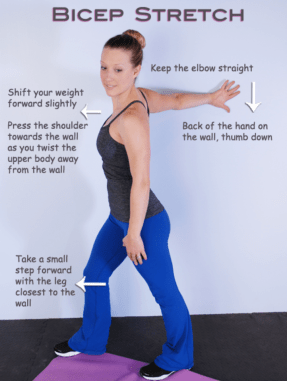
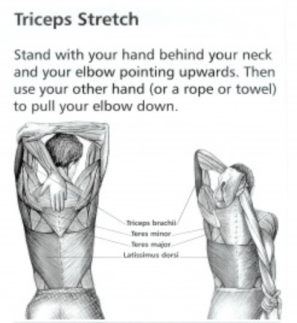
Arm Stretches
Arm Stretches: We don’t pay much attention to our arms so after this tough workout it’s important to give them a good stretch. :30 for each one will help with the stiffness and soreness.
We already run…that strengthens our legs enough right?
Running does make your legs stronger than if you were just walking or simply sitting on the couch. Whether you are running sprints or distance, you’re building muscular strength and/or endurance, but that is no excuse for not taking better care of your legs with strength training! Especially is you want to keep running on them for years to come!
In fact, of all the things that influence your running, strength training is one of the biggest factors that will impact your health, fitness, and performance.
A lot of runners, both male and female, do weight and resistance training for their upper-body but completely blow off lower-body weight training because they believe that running is enough to strengthen their legs. The reality is, running alone isn’t the best way to strengthen and maintain your legs for life.
Strength training the lower body gives you strength, stability, balance, and added support for running. It can also prevent injury.
The major muscle groups we use in sprinting or distance are the calves, quadriceps, hamstrings, and glutes. Your upper body including your arms, shoulders and low back are recruited for momentum and stability and we know our core is what holds it all together. A weak core, which includes our hips, can lead to all kinds of running injuries.
We’ll talk about our core upper body another day….today it’s all about the legs!
Depending on what kind of running you are doing (sprints or distance) you are either conditioning muscular strength or muscular endurance in your legs. Essentially, your body contains 2 different types of muscle fibers:
Type I (Slow Twitch): Your body uses its slow twitch muscle fibers to run distances. Slow twitch fibers aren’t as strong as Type II fibers, but can work for extended periods of time without fatiguing.
Type II (Fast Twitch): These are the muscle fibers you recruit when you are running faster. They are strong and explosive, but fatigue quickly.
We our working our legs in order to strengthen those Type I & Type II muscle fibers and give them the power to fire when we need them.
Day 1 exercises: Quads, Hamstrings, Glutes, and Calves – Sets = 2 – 3 x 10
Squats
Single Leg Balance
Pistol Squats
:60 Wall Sit
If you are running today, throw in the wall sit immediately after your run when your legs are fatigued. Great time to build strength!
You are probably already familiar with these exercises. They will fire up all the important muscles in our legs when done correctly. Check out the how to videos below for a reminder on form.
Squats: Chances are you’ve done a squat, but have you really done one correctly? Before even grabbing a set of dumbbells or trying a squat variation, watch this video to make sure your form is on point. You’ll learn what the body should look and feel like during a squat and what other exercises can help you master this one correctly. But, most importantly, you’ll be saving yourself from major injury.
Single Leg Balance: Great exercise to strengthen our glutes and lengthen our hamstrings and calf muscles!
Pistol Squats: This is a longer video but a REALLY good one if you’ve never attempted a Pistol Squat before. These are tough…so start high and work your way down to a lower position. Everything little bit counts!
Wall Sit: The wall sit is a really great exercise to target the entire thigh area, your quad, your inner thigh, the back of the leg, the hamstring, and your glutes.








 It looks hard on paper…and it’s not a walk in the park…but today is going to be fun and you CAN do it!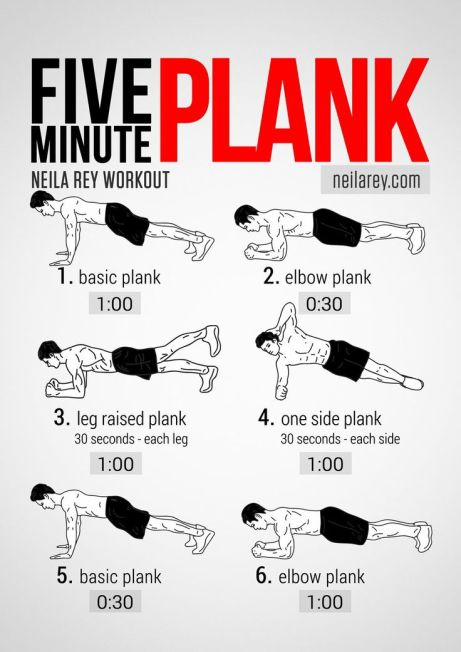

 !
! Strong to the Core