

Squats are a simple, classic exercise that should be part of every runner’s routine because they build functional strength that carries over to better running.
Squats activate the glutes, hips, hamstrings, quads, calves, and core muscles in a bent-knee position, which builds running-specific power to propel you forward. They also create functional strength through the legs and hips, develop proper range of motion in the ankles, and shore up muscle imbalances to prevent the risk of injury. Strengthening these muscles also guards against injuries like runner’s knee and iliotibial-band syndrome.
No two squats are the same, so as we get farther into the month it’s important to switch things up. A change in stance, load positioning, and technique can dramatically alter the focus of your squats, allowing you to better hammer your glutes, prep your quads for hills, or improve your stability when you need it.
Of course I put this together before I looked at the squat calendar and realized it’s a “rest day.” 
I won’t load you up with extra squats, but I do want us to try out a new version as our bonus exercise today so you’re ready to switch things up once the numbers get higher. Check out the squat variations recommended by the recent Runner’s World article, “6 Squat Variations Every Runner Should Do: To be a better runner, you need squats—and multiple types” below.
Day 5 exercises: 2 sets of 10
****Click here for how to videos****
- Squats
- Side Lunges – 2 sets on both legs
- Wall Sit – :60 (2X)
- Plank: :60 – Your Choice
Bonus: Squat of your choice – 2 sets of 10 – Choose from the squats below
Challenges:
- Burpees – 25
- Push Ups Beginner – 6
- Push Ups Advanced – 20
- Squats – Rest Day
Bonus Squat Options
Single-Leg Squat:  Once you’ve mastered bodyweight squats, switching to single-leg squats (a.k.a. pistol squats) is a great, gear-free way to increase loads and build max strength for each leg. “Running is nothing more than pushing off one leg at a time while maintaining balance.”
Do it: Stand tall with your feet together, and extend one leg and both arms out in front of you. Slowly, and under control, lower down as far as you can before you feel your form break, body sway, or your working leg “give out.” Pause briefly at your greatest depth and then push through your heel to return to standing. Start with shallow squats, or consider lowering down onto and off a chair. As you get stronger, go deeper. Perform all reps and then repeat on the opposite side. Do three to four sets of six to 10 reps, prioritizing proper form over rep number.
Tip: If you hold a dumbbell or weighted object out in front of you throughout the exercise. It will act as a counterbalance and actually make things easier.
Low-Bar Back Squat: 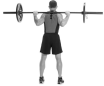 This move involves placing the barbell across the upper back, rather than on top of the shoulders, upping the demand placed on the glutes, says Jason Fitzgerald, a 2:39 marathoner, USA Track & Field-certified coach, and founder of Strength Running. That’s huge, as the glutes tend to be underdeveloped in runners, contributing significantly to lower-body injuries.
Jump Squat to Box: 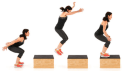 Adding an explosive, plyometric element to your squats strengthens your legs’ elastic properties and trains your muscles to generate more force in less time, Hamilton says. Those are major benefits to anyone regularly pounding the pavement.
Do it: Stand tall with your feet between hip- and shoulder-width apart, facing a short box. Hinge at the hips and bend your knees to lower your body into a squat. As you lower, slowly cock your arms behind you. Once your thighs are just above parallel with the floor, explosively jump up and forward, swinging your arms up overhead. Land as quietly as possible back into the squat position on top of the box. Step down, rest for a few seconds, and repeat. Perform four sets of six reps.
Tip: Work up to these. Any jumping during your workouts is best saved until you’ve already built up a base level of strength. It’s also best to begin with shorter boxes (under 12 inches) and work to taller ones.
Weighted Overhead Squat:  “I love this lift, which is executed just like a regular squat with a bar held above the head, because it’s less about strength and more about mobility, control, and balance—elements of general athleticism that are important for runners who tend to only run.” Fitzgerald says.
Rear Foot Elevated Split Squat: 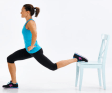 Another single-leg exercise, this one hones balance while also training the gluteus medius to a higher degree than many squat variations. For those commonly plagued by IT band and other knee issues, this is a must.
 “By holding the barbell across the front, rather than the back, of the shoulders, this is a more quad-dominant squat,” Fitzgerald says. This exercise presents a great opportunity for runners to train their quads eccentrically—or as they lengthen. Doing so will make running downhill feel easier.
Do it: Stand facing a barbell so that it sits on the front of your shoulders, and either grasp the bar with a grip just wider than shoulder-width apart. Choose a grip position that allows you to keep your upper arms parallel to the floor throughout the entire exercise. Stand up with the bar and take a couple steps back. From here, stand with your feet between hip- and shoulder-width apart, and slowly hinge at the hips and knees to lower your body as deeply as you can without breaking form, feeling discomfort in your joints, or lifting your heels off of the floor. Focus on lowering into each squat as slowly as possible to emphasize the eccentric action of your quads. Pause, then push through your heels to return to start. Perform three sets of 10 reps
Tip: Perform this exercise with just the barbell, and work up to adding weight plates. If the barbell feels too heavy, you can also perform this exercise by holding a dumbbell in each hand just in front of your shoulders. Most people cannot front squat as much weight as they can back squat.
I know I know…it’s a squat rest day…you’ll live…it’s only 2 sets of 20.
It’s almost the weekend so let’s…..

 Strong to the Core