Day 7: Hips and Core – Strength and Balance

screen-shot-2017-02-07-at-5-08-05-am

Lots of us have gone to the chiropractor and been told we are unbalanced. We can see this in running pictures too…but there are ways to correct this without expensive, thrice weekly doctor visits.

How? Strengthen our hips and core and work on our balance. By strengthening these areas, we are more likely to stand tall and keep our body in line at the end of a long race or training run.

Keeping our spine and hips in line keeps our oxygen flowing, allows our legs and knees to remain stable, and helps us avoid pain and injuries in our lower extremities.

It happens to all of us. At the end of a long race or training run, we tend to slouch and let our posture fall. We are tired and we just want to finish so our brain forgets and we begin to let things fall apart.

Below are images of me at Rock N Roll Savannah back in November before we started doing a lot of hip strength and balance work wearing my knee brace and consistently suffering from knee pain.

(Excuse the watermarks…I didn’t purchase these photos)

Since then I have dedicated a lot of time to hip strength and it has paid off. My posture has gotten  much better and my knee pain has all but disappeared. Case in point, see the pictures below from this past weekend at Rock N Roll New Orleans. Hips and aligned and knee brace is gone…and so is the pain in my knees.

I’ll never say “don’t see a doctor,” but if you’re having on-giong pain, and can’t figure out how to make it go away, strengthening your hips is a great start. I saw many different doctors, had x-rays and MRI’s and even cortisone shots in both knees…but until I started getting stronger in these area, nothing took the pain away.

It’s important to stretch and roll our legs too…I know I know…so many things to do…but as athletes, we must use every tool in our arsenal to be healthy and strong in order to stay on the road pain free.

Today’s hip strengthening and balance exercises had been key parts of my journey and I hope you embrace these exercises and make them part of your tool kit to success too.

Day 7 exercises: Hips strength video is found below and how to videos for single leg deadlifts and squats are in the link below.

****Click here for how to videos****

  • Modern Moms/Dads Hip Strength -1X all the way through on each side
  • Single Leg Deadlifts – 2 sets of 10 for each leg
  • Squats – 2 sets of 10
  • Plank – :60
  • Wall Sit – :60

https://youtu.be/Ebc11SrkqWk

Challenges:

  • Superman – :40
  • Push Ups – 30
  • #MadManMartin Plank Challenge – Plank for additional :45

Speed Work: Everyone’s favorite speed work and undoubtedly the least dreaded is 1/4 mile repeats. So this week, it’s time to put some pep in your step and pour on the speed.

Workout – 6X-12X 400M (1/4 mile) – If you are just easing into speed work for the first time. Keep it short and do 1/4 mile repeats 6 times for a total of 1.5 miles. If you’ve been doing this for a while now, and are training for a longer distance race…don’t be lazy…get in those 12 1/4 mile repeats for a total of 3 miles of speed work. Remember to warm up AND cool down. Both are very important parts of this workout. If you have questions, reach out to me. Let’s chat about how to make this work for you.

1/4 mile repeats can be done on the track, treadmill, or on the road with a GPS watch. Do whatever works for you…but don’t skip it. I know it can be daunting…but speed work will not only help you get faster, but it will also help you increase your breathing abilities and make your long runs easier.

Warm-Up  5:00 jog followed by your choice of Dynamic Movements (high knees, butt kicks, leg swings, sideways shuffles, skipping, etc)

Work-Out – 6-8 x 1/4 Mile Repeats at a pace that is :30 faster than your race pace.

*1:00 standing or walking rest in between each set.

1/4 Mile is equivalent to 400 meters or one lap of a standard-sized track.  Here’s a few examples of where your interval times would range, depending on your mile time.

  • If you run a 14:00/mile, you should run the quarter-mile in 3:00.
  • If you run a 13:00/mile, you should run the quarter-mile in 2:45.
  • If you run a 12:00/mile, you should run the quarter-mile in 2:30.
  • If you run a 11:00/mile, you should run the quarter-mile in 2:15.
  • If you run a 10:00/mile, you should run the quarter-mile in 2:00.
  • If you run a 9:00/mile, you should run the quarter-mile in 1:45.
  • If you run a 8:00/mile, you should run the quarter-mile in 1:30.
  • If you run a 7:00/mile, you should run the quarter-mile in 1:15.

Cool-Down  5:00-10:00 easy jog (you’ve earned it!)


That’s all for today Crew. Let’s keep working on our hip strength and balance so we can stop that annoying lower extremity pain and stay on the road doing what we love…running!


screen-shot-2017-02-07-at-5-47-45-am


Day 3: Booty Blast

screen-shot-2017-01-03-at-5-13-30-am

It’s for the booty….but runners know it’s also for the hips!

An article in RunnersConnect.com called “How and Why You Should Strengthen Your Hip Abductors” says,

We often hear about how running is “all about the hips”, and how the source of all your running injuries is weakness in the muscles around your hips, but what does that mean?

Which hip muscles are so critical to success as a runner?

Turns out your hip adductor and abductor muscles are a huge part of you being able to stay healthy as a runner, and if they are neglected, you are putting yourself at serious risk of an injury.

In the article Proper Running Form: Does Gravity Help You Run Faster?, we considered the importance of hip extension in running, and noted that in cases of runners with restricted mobility in the front of the hips, we often see a forward drop of the pelvis, highlighted by an increase in the curve of the lower back.

What does that mean? The body succeeds in traveling over the supporting leg, but without making optimum use of the powerful Gluteus maximus(the main muscle of the buttock).

As a result, stride length becomes compromised, propulsion is reduced, overall effectiveness of the running gait cycle is inhibited and risk of injury potentially raised.

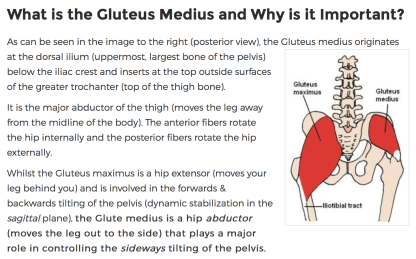
The Gluteus Medium, a smaller but equally important member of the glute family – contributes to what is commonly known as the “hip drop”.

screen-shot-2017-01-03-at-5-26-48-am

An excerpt from RunnersConnect.com

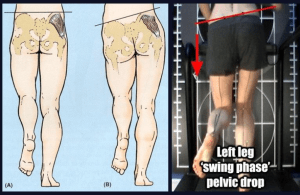
The Trendelenburg gait is exhibited by a person who through weakness in the abductor muscles, cannot maintain sufficient height of the opposite side of the pelvis to raise the foot and transfer weight to the other leg.

Instead, the pelvis drops downwards, meaning the affected person has to bend their leg more than usual at the knee in order to make up for the lack of lift.

To compensate, the stride on the unaffected side typically becomes shorter, along with a tendency for the person to lurch towards the weakened side in an attempt to maintain a level pelvis.

We’ve talked about this “hip drop” before, noting that almost every runner has some form of weakness in their glutes contributing to this issues. Check out the image below…

screen-shot-2017-01-03-at-5-30-55-am

What does this “hip drop” lead to?

Various studies have shown a link between Gluteus medius weakness and athletic injury:

  • In a study by Fredericson et al (2000), 24 distance runners with Iliotibial Band Syndrome had the hip abductor strength of their injured limb compared to that of the non injured limb (and to that of a control group). It was found that on average Gluteus medius strength was 2% less on the injured side.
  • After a six-week rehabilitation period with particular focus on strengthening the Gluteus medius (side-lying hip abduction and pelvic drops), 22 of the 24 injured athletes were pain-free and able to return to running. Furthermore, a six-month follow-up showed no reports of recurrence.
  • Other studies have also linked weaker hip abductors and external rotators to Patellofemoral Pain Syndrome (Ireland et al.,2003; Robinson et al.,2007; Cichanowski et al.,2007).

Yep you got it…tight hips, IT Band pain, knee pain, and so on right down the legs. It’s all connected!

So what do we of about it? Blast that booty and build stronger butt muscles! Let’s do this!

Day 3 exercises: 2 sets of 10

****Click here for how to videos****

  • Donkey Kick + Fire Hydrant
  • Butt Lift Bridge
  • Clams
  • Plank – :60 (Your choice of plank)

Bonus: Side-lying hip abduction – 2 sets of 10 

side-abduction

To work the right hip abductor muscles (as in the photo):

  • Lie down in a left side-lying position. Make sure your hips are “stacked” (right hip directly over the left hip) and that your body is in a straight line.
  • Placing your top hand on the floor in front of you can help ensure that you are not leaning forwards.
  • Your pelvis should be in a neutral position (not hitched or tilted forwards/backwards).

January Challenges:

  1. Burpees – 15
  2. Push Ups Beginner – 4
  3. Push Ups Advanced – 15
  4. Squats – 75

Speed Work Options: “If you want to run faster, you have to run fast!”

Do you have a plan to get your speed work in? You’ve got options so decide when it will happen and go get you some speed!

  1. On the Track: “High-intensity track sessions move the muscles through the full range of motion, improving elasticity and enhancing coordination between your nervous system and muscles. With time, you’ll develop a more efficient stride at all your paces.”

    HIIT It: Begin with two 100-meter accelerations that include 40 meters at top speed, with 2 to 3 minutes of walking or jogging between.

    Build to 6 x 150 meters hard, including 80 meters at top speed, with 3 to 4 minutes jogging or walking rest.

    Over time, increase the number of repeats to 10, lengthen reps to 300 meters (running nearly the entire distance at top speed), or reduce the rest interval to one minute.

  2. On the Hills: Inclines are a great venue for superfast speedwork. Compared with a flat surface, hills reduce the impact on your legs and limit your range of motion, thereby lowering the risk of strains and pulls. Plus, hill repeats build muscle power, which helps you run more efficiently on level ground, says McConkey.

    HIIT It: On an incline, start with three 30-second moderate repeats and walk down the hill for recovery.

    When this becomes comfortable, progress to 4 x 1 minute near all-out efforts with a downhill jog and an additional 30 to 60 seconds jogging or walking rest.

    Over time, add additional reps, extend effort length up to two minutes, and aim for steeper hills.

Speed Workouts for Beginners: When you’re just starting out, any type of interval—even alternating walking with jogging—will challenge your body in new ways.

Incorporate one of the following workouts each week to introduce intensity and boost your speed.

  1. Track: Run two laps. On the straights, accelerate and hold top speed for 20 meters. Walk the curves.
  2. Trail: Intersperse an easy run with 3 to 4 20-second, moderate-intensity surges.
  3. Hills: Do an easy run that incorporates three 20-second climbs, each one at a moderate effort.

What else should we be doing today? Well…Tuesday is always a great day for a No Junk Food Challenge! And I need it…yes I do need to be reminded to eat well. So here’s to a fabulous day of sweating, eating right, and of course….

screen-shot-2017-01-03-at-5-47-26-am